How to Generate 30 Days of Social Media Content in 30 Minutes With AI
Table of Contents
Keeping up with social media can feel like a full-time job.
Between brainstorming fresh ideas, writing captions, creating visuals, and figuring out what to post next, even experienced marketers can find themselves scrambling for content at the eleventh hour. For small business owners juggling sales, customer service, and daily operations, maintaining a consistent posting schedule can be even more challenging.
However, you don’t need to spend hours every week planning your social media posts. With the right strategy and AI-powered tools, you can significantly reduce the time spent on content planning while keeping your brand visible and relevant.
The opportunity is worth exploring. According to HubSpot’s 2026 State of AI in Marketing report, 80% of marketers use AI for content creation, while 75% use it for media production. The report also found that about one-third of marketers said AI saves their team 10 to 14 hours per week, with another third reporting savings of more than 15 hours weekly. These findings highlight AI’s potential to streamline repetitive tasks and give marketing teams more time for strategy, creative development, and audience engagement.
In this guide, we’ll explore how to generate 30 days of social media content in 30 minutes, organize your monthly publishing schedule, and use AI without losing the human touch that makes your brand memorable.
Why Is Planning 30 Days of Social Media Content Worth It?
Let’s face it: Consistency is easier said than done. You might start Monday with plenty of ideas, only to hit a creative wall by Wednesday. Before you know it, another week has gone by without a single post.
A 30-day social media content calendar helps you break that cycle. More importantly, it gives every post a purpose and ensures your messaging remains aligned with your business goals.
Planning ahead offers several practical benefits:
- Saves time: Brainstorm ideas, organize captions, and map out publishing dates in batches rather than switching between tasks every day.
- Keeps your messaging consistent: Maintain a recognizable brand voice across your social media channels.
- Reduces creative burnout: Spend less time staring at a blank screen and more time developing ideas that resonate with your audience.
- Supports business goals: Connect your posts to product launches, seasonal campaigns, promotions, and lead-generation activities.
- Makes performance tracking easier: Review your monthly results and identify which topics and formats deserve another shot.
Consider a small e-commerce business preparing for a seasonal promotion. Without a calendar, the marketing team might publish product photos one day, scramble for a promotional caption the next, and forget to follow up with customer testimonials.
With a monthly plan, the team can map out product education, customer stories, promotional announcements, and frequently asked questions in advance.
The result is a more coordinated campaign and fewer last-minute decisions.
How to Generate 30 Days of Social Media Content in 30 Minutes With AI
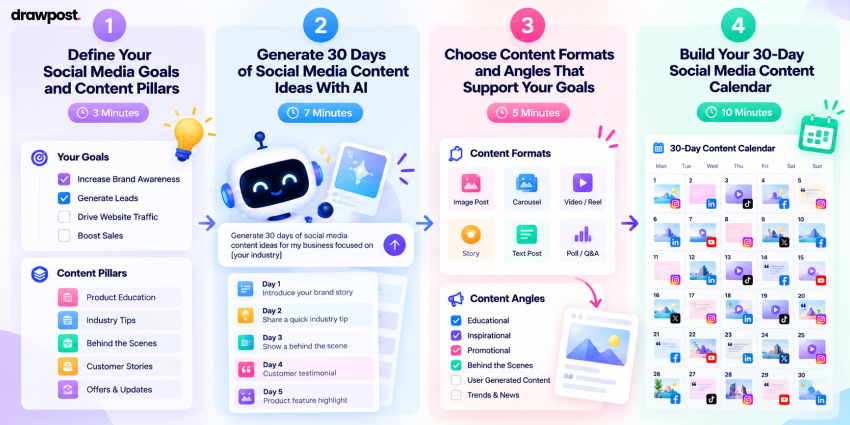
The key to planning a month’s worth of social media content quickly is to work in batches. Instead of switching between brainstorming, writing, formatting, and scheduling, complete similar tasks together.
This process combines AI social media content planning with a structured workflow, helping you move from scattered ideas to a practical monthly publishing schedule.
The following five-step approach divides your 30 minutes into manageable stages. It focuses on planning and organizing a month’s content ideas, rather than creating, designing, reviewing, and publishing 30 finished posts in that time.
Step 1: Define Your Social Media Goals and Content Pillars (3 Minutes)
Before generating content ideas, take a step back and decide what you want your social media activity to accomplish.
Creating 30 posts is relatively straightforward. Creating 30 posts that contribute to your business goals requires more thought.
Start by identifying one or two primary objectives for the month. You might want to increase brand awareness, drive website traffic, generate qualified leads, promote a new product, or strengthen customer relationships.
Next, consider your target audience. What challenges are they facing? Which questions do they ask most often? What information would help them make better purchasing decisions?
Once you understand these needs, organize your content around three to five content pillars.
For example, a B2B software company might focus on:
- Educational content: Explain industry challenges, share practical tips, and simplify complex concepts.
- Product insights: Demonstrate features and explain how they address customer pain points.
- Customer success stories: Showcase testimonials, results, and lessons learned.
- Industry commentary: Share informed perspectives on emerging trends and business developments.
- Engagement posts: Ask relevant questions and encourage discussions with your audience.
These pillars give your content direction. They also help you avoid publishing the same type of post repeatedly.
Most importantly, connect each pillar to a business objective. Educational content can build credibility, customer stories can reduce purchasing uncertainty, and product-focused posts can encourage qualified prospects to take the next step.
Time allocation: 3 minutes
By the end of this step, you should have a clear monthly objective and a shortlist of content pillars to guide your planning.
Step 2: Generate 30 Days of Social Media Content Ideas With AI (7 Minutes)
Now comes the brainstorming stage.
Instead of developing 30 individual ideas manually, use an AI social media content generator to explore topics based on your industry, audience, content pillars, and marketing objectives.
The key is to focus on specificity rather than volume. A list of 100 generic ideas won’t necessarily help your business. Thirty relevant ideas that address genuine customer needs can be far more valuable.
For example, a fitness studio could develop content around beginner workout mistakes, realistic nutrition habits, common training misconceptions, and ways to stay consistent with exercise.
Similarly, a SaaS company could cover common implementation challenges, feature comparisons, customer success stories, and practical ways to improve team productivity.
AI can also help identify different angles for an existing topic. A single subject might become an educational carousel, a short-form video, a LinkedIn discussion, and a customer-focused post. This makes it easier to build a diverse collection of social media content ideas without starting from scratch every time.
However, don’t accept every suggestion at face value. Review the ideas, remove repetitive topics, and prioritize those that align with your expertise and audience’s needs.
You should also consider the questions your sales and customer support teams hear regularly. These conversations can reveal useful content opportunities that generic brainstorming might overlook.
To make the process more efficient, organize your ideas by content pillar and spread them across the month. This helps you maintain variety without losing sight of your business objectives.
Time allocation: 7 minutes
By the end of this step, you should have a list of 30 relevant topics organized around your chosen pillars.
Step 3: Choose Content Formats and Angles That Support Your Goals (5 Minutes)
Once you’ve shortlisted your topics, decide how each idea should be presented.
Your calendar shouldn’t consist entirely of text posts or promotional graphics. Different formats serve different purposes, so building variety into your schedule can help you communicate more effectively.
Visual content, in particular, deserves consideration.
According to HubSpot’s 2026 marketing statistics, marketers identified short-form video as the leading content format for reported marketing ROI, at 49%. Long-form video followed at 29%, while live-streaming video accounted for 25%.
These findings suggest that video deserves a place in many content strategies, although the right format will depend on your audience, resources, and campaign objectives. You don’t need to turn every idea into a video. Instead, choose the format that communicates your message most effectively.
Here are some options to consider:
- Static graphics: Share quick tips, announcements, statistics, and product highlights.
- Carousels: Break complex topics into bite-sized, easy-to-follow slides.
- Short-form videos: Demonstrate products, answer common questions, or explain a process.
- Infographics: Present data, comparisons, and workflows visually.
- Customer stories: Use authentic customer experiences to demonstrate the value of your offering.
- Text-based posts: Share professional insights, opinions, and industry discussions.
For example, a marketing agency could turn a lead-generation blog into a carousel covering common mistakes, a short video explaining one practical improvement, and a LinkedIn post discussing the broader business implications.
This approach helps you get more mileage out of existing content without repeating the same message in the same way.
At the same time, make sure each format suits the platform and audience. A useful LinkedIn carousel might require a different presentation than an Instagram Reel covering the same topic.
As you finalize your choices, consider the resources available to your team. A content format should be practical to produce consistently, not just attractive on paper.
Time allocation: 5 minutes
By the end of this step, each content idea should have a suitable format, platform, and angle.
Step 4: Build Your 30-Day Social Media Content Calendar (10 Minutes)
Now that you have your ideas and formats, organize them into a publishing schedule that supports your business goals.
A Social media content calendar generator can help structure posts by date, platform, content type, and campaign objective. It also gives you a clear overview of what your audience will see throughout the month.
Start by distributing your 30 ideas across the month. Alternate educational posts, product or service updates, engagement content, customer stories, and promotional messages to keep your publishing schedule balanced.
Here’s an example of a weekly structure you can adapt to your business.
| Day | Content Type | Example Post |
| Monday | Educational | Three ways to solve a common customer problem |
| Tuesday | Engagement | Ask followers about their biggest industry challenge |
| Wednesday | Product or service | Explain a feature and its practical business benefits |
| Thursday | Behind the scenes | Introduce a team member or demonstrate your process |
| Friday | Thought leadership | Share an industry observation or actionable lesson |
| Saturday | Customer-focused | Highlight a testimonial or customer success story |
| Sunday | Promotional or inspirational | Share an offer, business milestone, or weekly takeaway |
You don’t necessarily need to publish seven days a week. Your ideal posting frequency depends on your audience, available resources, and platform.
For a small marketing team, three high-quality posts each week may be more sustainable than publishing every day without a clear strategy. You can also reuse strong ideas across different platforms by adapting their format and presentation.
As you build your calendar, include these details for each planned post:
- Publishing date and platform
- Content topic and pillar
- Format and creative direction
- Campaign or business objective
- Call to action
- Content production or approval status
Keeping these details together makes upcoming work easier to review and manage. It also helps your team identify gaps in the schedule before they become last-minute problems.
Additionally, leave room for timely industry developments, relevant conversations, and unexpected opportunities. A calendar should keep you organized, not tie your hands.
Time allocation: 10 minutes
By the end of this step, you should have a complete monthly calendar with each idea assigned a publishing date, platform, format, and purpose.
Step 5: Review and Finalize Your Monthly Content Plan (5 Minutes)
Before wrapping up, review your calendar to ensure the planned content is relevant, balanced, and realistic.
AI can accelerate content planning, but human judgment remains essential. A calendar filled with repetitive topics, generic messaging, or unrealistic production requirements won’t deliver much value.
Use these five checks to refine your plan:
- Check content variety: Make sure the calendar includes a healthy mix of educational, promotional, engagement, and customer-focused content.
- Review brand alignment: Confirm that the planned topics reflect your brand voice, expertise, and business objectives.
- Identify repetition: Remove overlapping ideas or give similar topics different angles.
- Confirm platform suitability: Check whether each format makes sense for the intended platform and audience.
- Verify feasibility: Ensure your team has enough time and resources to create the planned content.
You should also check whether important campaigns, seasonal events, product launches, or company announcements are reflected in the calendar.
At this stage, avoid spending time polishing every caption or creating all the visuals. The objective is to complete a practical monthly plan that your team can execute after the planning session.
Once the calendar is finalized, move individual posts into production. This includes drafting and editing captions, designing graphics, recording videos, checking factual claims, and obtaining approvals where necessary.
Time allocation: 5 minutes
By the end of the 30 minutes, you should have a structured content plan covering the next month, with clear topics, formats, publishing dates, and objectives.
How to Make Content Production More Efficient After Planning
The 30-minute workflow gives you a starting point for consistent publishing. However, planning a month’s content and producing 30 finished posts are two different tasks.
Once your calendar is ready, use social media content batching to break production into manageable sessions. For example, dedicate one session to writing captions, another to designing graphics, and another to recording short-form videos. This reduces the need to switch between creative tasks throughout the week.
You can also use AI to accelerate specific production activities, such as refining captions, generating alternative headlines, adapting a post for another platform, or outlining a short video.
The result can be a collection of AI-generated social media posts that serves as a starting point for human review, rather than content that goes straight from generation to publication.
Review every draft before publishing. Verify statistics, check claims, remove generic language, and add examples or perspectives that reflect your brand’s experience.
The goal is to use AI to reduce repetitive work without sacrificing originality, accuracy, or audience trust.
How to Organize Your Social Media Calendar Efficiently
Creating good content is only half the battle. You also need a reliable system for organizing it.
Without a central calendar, marketing teams can end up juggling spreadsheets, scattered documents, design files, and message threads. This creates unnecessary friction, especially when several people contribute to the same campaign.
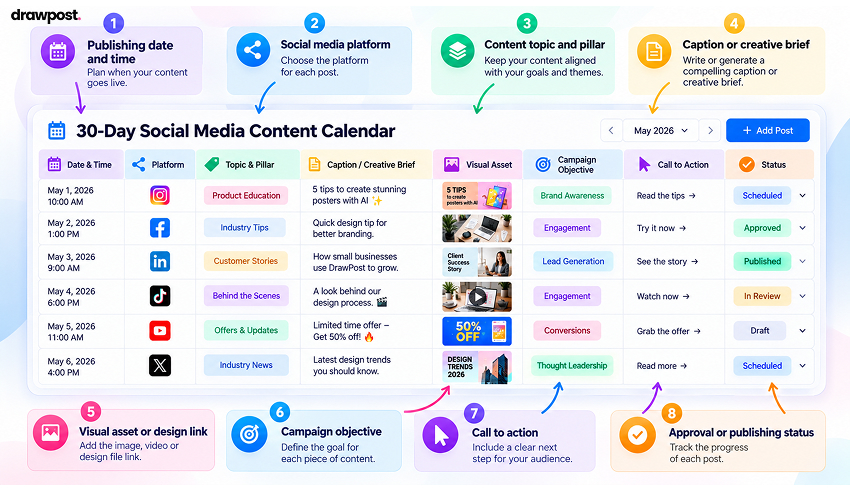
A well-organized calendar should include:
- Publishing date and time
- Social media platform
- Content topic and pillar
- Caption or creative brief
- Visual asset or design link
- Campaign objective
- Call to action
- Approval or publishing status
Keeping these details together makes upcoming work easier to review and manage.
For instance, a marketing manager can quickly identify gaps in the publishing schedule, while a content creator can see which captions need revision and which visuals are still outstanding.
It also becomes easier to coordinate product launches, seasonal promotions, and company announcements across multiple channels.
For teams managing several channels, social media scheduling tools can help organize publishing dates and coordinate approved content. Depending on the tool, they may also support queue management, scheduling, and collaboration.
Automated social media posting can reduce manual publishing tasks, but automation should not replace quality checks. Review scheduled content for accuracy, confirm that links and creative assets work, and stay prepared to respond to relevant events or audience conversations.
For small businesses, reducing administrative work allows the team to devote more attention to customer research, creative development, and campaign performance.
An effective planning process should remove unnecessary steps while keeping people involved in the decisions that shape the brand’s message.
Measure Results and Improve Your Next Content Calendar
Your work doesn’t end when the final post goes live. In fact, the insights you gather throughout the month can make your next content calendar more effective.
At the end of the month, review your performance and look for patterns.
Which posts generated meaningful engagement? Which topics drove website traffic? Did educational carousels outperform promotional graphics? Which calls to action encouraged people to take the next step?
Your evaluation should reflect your business objectives.
For brand awareness, reach and impressions can help you understand how widely your content is being distributed. For engagement, examine comments, shares, and saves. If lead generation is your priority, pay closer attention to website visits, inquiries, and qualified conversions.
Avoid focusing exclusively on likes. A post with fewer interactions might still generate valuable business inquiries.
You can also use AI to identify recurring themes in your top-performing posts and suggest related topics for future campaigns. However, treat these suggestions as hypotheses to test rather than guaranteed outcomes.
Over time, this feedback loop helps you move beyond guesswork. Instead of simply producing more content, you can focus on publishing material that serves your audience and supports measurable business goals.
Common Mistakes to Avoid When Using AI for Social Media Planning
AI can make content planning faster, but a few common mistakes can undermine your efforts.
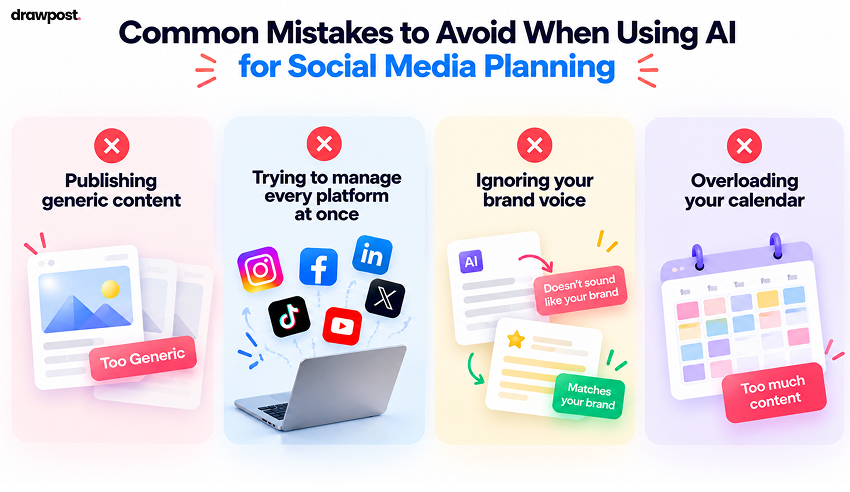
Publishing generic content: If your posts could belong to any business in your industry, incorporate specific examples, original insights, and customer-focused details.
Trying to manage every platform at once: Start with the channels that matter most to your audience. Expand only when your workflow can support the additional workload.
Ignoring your brand voice: Review AI-generated drafts to ensure they reflect your business’s personality, expertise, and communication style.
Overloading your calendar: A realistic publishing schedule you can maintain is more valuable than an ambitious plan that falls apart after a week.
Chasing every trend: Sprout Social’s 2026 Social Media Content Strategy Report highlights the importance of human-generated content and platform-specific strategies. Rather than jumping on every viral trend, focus on creating content that feels relevant to your audience and fits your brand. A trend is worth exploring only when it supports your message and gives your audience a genuine reason to engage.
Forgetting to measure results: Track metrics that align with your objectives and use those insights to refine your next month’s content.
Ultimately, AI works best when you combine its speed with human judgment. Let technology handle repetitive tasks while your team focuses on strategy, creativity, and building genuine relationships with customers.
Conclusion: Plan 30 Days of Social Media Content in 30 Minutes With Drawpost
Creating a month’s worth of social media content doesn’t have to consume your workweek. With a clear strategy, AI-assisted content creation, and an organized planning process, you can turn scattered ideas into a structured publishing schedule in significantly less time.
Start by defining your business goals and identifying relevant content pillars. Then, develop ideas that address your audience’s challenges, choose formats that suit your message, and organize your posts into a monthly calendar. Finally, review the plan and measure results to improve your next content cycle.
For business owners, marketers, agencies, and social media managers, the real advantage isn’t simply publishing faster. It’s having more time to focus on the activities that drive growth, from understanding customers to improving campaigns and developing stronger brand relationships.
That’s where Drawpost comes in.
Drawpost is an AI-powered social media tool designed to help you generate 30-day social media content while simplifying content planning and organizing your publishing calendar more efficiently. Instead of spending hours switching between ideas and planning tasks, you can streamline your workflow and bring your monthly content strategy together in one place.
Ready to leave the last-minute scramble behind?
Visit drawpost.app and use Drawpost to plan your monthly content more efficiently, so you can spend less time planning and more time growing your business.
Frequently Asked Questions
Q. How can you create 30 days of social media content in 30 minutes?
Start by defining your marketing goals, target audience, and three to five content pillars. Use AI to generate a month’s worth of topic ideas, organise them into a content calendar, and draft captions in batches. Allocate time for reviewing and refining the content before scheduling it. Reusable templates and a clear workflow can make the process faster, although the time required depends on content complexity and the level of editing needed.
Q. What information do you need before using AI to plan a month’s social media content?
Before using AI, prepare your target audience profile, brand guidelines, marketing objectives, key offerings, preferred platforms, and content themes. Include information about your brand voice, campaign dates, and relevant industry topics. These inputs help AI generate more relevant content ideas and reduce the need for extensive revisions.
Q. How do you turn one content idea into 30 social media posts?
Start with a broad topic relevant to your audience and divide it into smaller themes. For example, a topic such as AI in marketing could generate posts covering benefits, practical applications, common mistakes, industry statistics, expert insights, and frequently asked questions. Adapt these angles into different formats, such as text posts, carousels, short-form videos, and infographics. Maintain variety by giving each post a distinct purpose and perspective.
Q. How can you keep AI-generated social media posts from sounding repetitive?
Vary your content formats, opening hooks, examples, perspectives, and calls to action. Instead of repeating the same promotional message, alternate between educational content, industry insights, customer questions, practical tips, and behind-the-scenes updates. Provide AI with clear brand guidelines and review every draft to remove generic language, repeated ideas, and unsupported claims.
Q. Can you use AI to create platform-specific social media content from one monthly plan?
Yes. A single monthly content plan can serve as the foundation for platform-specific posts. For example, one topic can become a professional insight post on LinkedIn, a visual carousel on Instagram, a discussion question on Facebook, or a short video script for YouTube Shorts. Adapt the length, tone, format, and call to action to each platform rather than publishing identical content across every channel.
Q. How do you schedule and publish a month’s worth of social media posts automatically?
First, finalise your captions, visuals, links, and publishing dates in a content calendar. Then use social media scheduling tools to upload approved content, assign publication times, and queue posts for the month. Review platform previews and confirm that each post is correctly formatted before scheduling. Monitor scheduled posts periodically because some content may require updates or manual publishing.
Q. How can you tell whether your AI-generated social media content is working?
Measure performance against your original marketing objectives. Track reach and impressions to evaluate visibility, engagement rate to understand audience interaction, link clicks to assess interest, and conversions to measure business impact. Compare results across topics, formats, and platforms to identify which posts perform best. Use these findings to improve your next monthly content calendar rather than focusing only on the number of posts published.