
Table of Contents
Key Takeaways
- A consistent brand voice helps maintain a recognizable identity across social media platforms, even when content formats and tones differ.
- Clear brand voice guidelines define personality traits, messaging principles, writing styles, and tone preferences for content creation.
- Platform-specific content adaptations help brands meet audience expectations without changing their core identity or communication style.
- Shared content guidelines, editorial workflows, and approval processes help multiple contributors maintain consistent brand messaging.
- AI-powered tools like DrawPost support brand-aligned content creation, scheduling, and publishing across social platforms while reducing repetitive work.
Managing a brand’s presence across multiple social media platforms is one thing. Making sure every post sounds like it comes from the same company is another. As content production increases, different writing styles, campaign priorities, and publishing needs can slowly change the way a brand communicates.
A LinkedIn post might reflect the company’s expertise, while an Instagram caption adopts an overly casual tone. Meanwhile, content created by another team member may use different messaging altogether. Individually, these posts might perform well, but collectively, they can create an inconsistent brand identity.
Maintaining a consistent brand voice across social media platforms requires a clear understanding of how your brand should communicate, supported by practical guidelines and coordinated content workflows.
The goal isn’t to make every post sound identical. It is to preserve what makes your brand recognizable while adapting to different platforms and audiences.
This guide explains how to achieve that consistency through defined brand guidelines, content collaboration, and smart automation.
What Does a Consistent Brand Voice Mean on Social Media?
Your brand voice is the personality people recognize in the way you communicate. It shows in your choice of words, the messages you share, and how you interact with your audience.
For example, consider a cybersecurity company that explains complex risks in simple language. Whether it shares insights on LinkedIn, answers customer questions, or publishes educational videos, its communication should remain clear and easy to understand.
That’s what a consistent brand voice on social media means. Every post doesn’t need the same format, but the brand’s personality, values, and messaging should remain consistent. This matters because potential customers often interact with a company several times before making a decision. They may discover it on social media, explore its website, read customer stories, and revisit its social channels.
A recognizable communication style helps create a consistent experience across these interactions.
Brand Voice vs. Brand Tone: What’s the Difference?
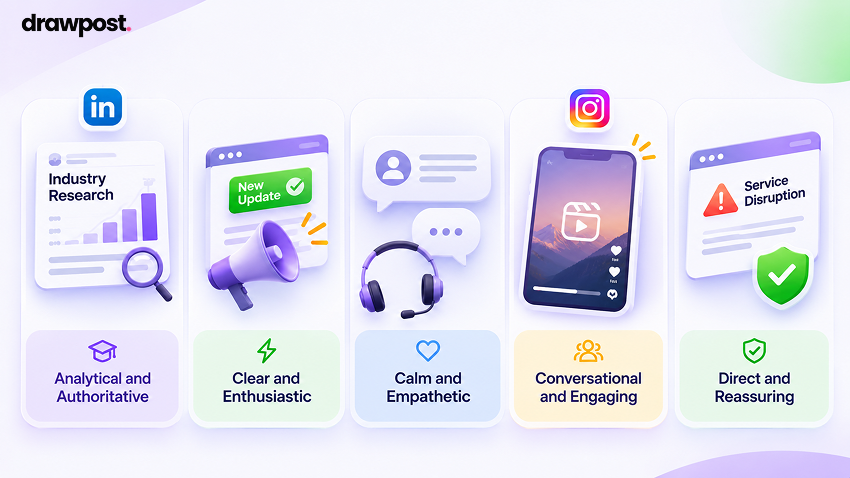
Although they’re closely related, brand voice and tone serve different purposes.
Brand voice describes who your company is. Brand tone describes how it communicates in a particular situation.
Imagine a B2B software company whose voice is confident, knowledgeable, and approachable. Its tone might change depending on the content:
| Situation | Appropriate Tone |
| Sharing industry research on LinkedIn | Analytical and authoritative |
| Announcing a product update | Clear and enthusiastic |
| Responding to a customer complaint | Calm and empathetic |
| Publishing an Instagram Reel | Conversational and engaging |
| Communicating a service disruption | Direct and reassuring |
The company’s personality remains recognizable, even though the delivery changes.
This distinction gives marketing teams room to create content that feels natural on each platform without compromising the brand’s identity.
How to Maintain a Consistent Brand Voice Across Social Media Platforms
Consistency becomes easier when brand voice is treated as part of the content production process rather than something editors check at the last minute.
The following seven steps provide a practical approach for B2B marketers, agencies, and growing content teams.
1. Define Your Brand’s Personality and Communication Style
Before deciding what your company should publish, establish how it should sound. Start by examining your brand’s positioning, values, audience, and competitive differentiation. These factors should influence the personality your communication conveys.
A company selling enterprise cybersecurity solutions, for example, may want to sound knowledgeable, dependable, and direct. A creative collaboration platform might prioritize accessibility, enthusiasm, and simplicity. Neither approach is universally better. The right voice depends on the business and its audience.
Choose three or four personality traits that genuinely represent your company. Then define what those traits mean in practice.
| Personality Trait | What It Means in Your Content |
| Knowledgeable | Share useful insights supported by evidence and experience |
| Approachable | Explain ideas without unnecessary jargon |
| Confident | Communicate clearly without exaggerated promises |
| Practical | Focus on useful advice, applications, and outcomes |
Avoid relying on adjectives alone. Words like innovative, professional, and friendly can mean different things to different writers. Translate them into observable writing behaviors. For instance, if your brand is approachable, does that mean using contractions, asking occasional questions, or explaining technical concepts through familiar examples? Once those decisions are clear, write a short brand voice statement.
Example:
We communicate complex business ideas with clarity and confidence. Our content is informative without being overly technical, approachable without being casual, and persuasive without making exaggerated claims.
A statement like this gives contributors a common reference point before they begin writing.
2. Create Clear Brand Voice Guidelines for Social Media
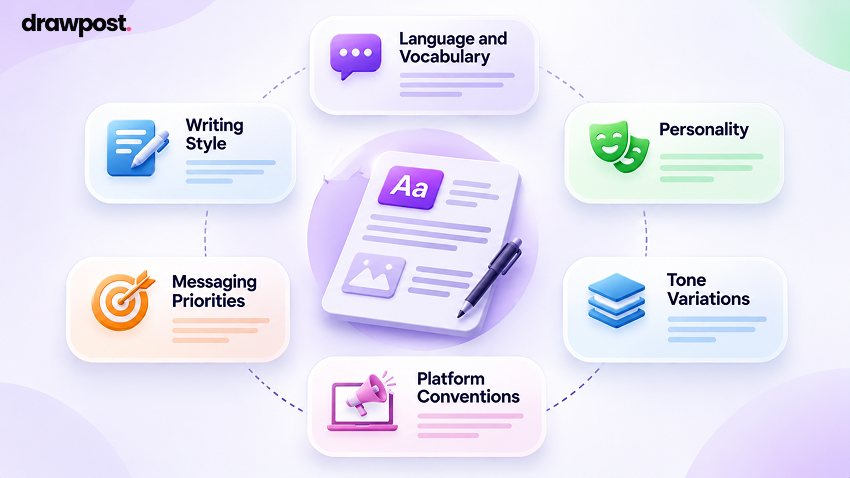
Defining a voice is the starting point. Documenting it makes that voice usable across the organization. Without written guidance, different people may interpret the same brand personality in different ways.
One writer might associate confidence with bold promotional language. Another might communicate confidence through research and factual explanations. Both believe they’re following the brand, but the results can look unrelated. Effective brand voice guidelines for social media should remove that ambiguity.
Start with the elements that influence everyday content decisions:
- Language and vocabulary: Preferred terminology, industry expressions, and words to avoid.
- Writing style: Sentence length, paragraph structure, readability, and formatting.
- Personality: The characteristics every post should communicate.
- Tone variations: How communication changes across educational, promotional, and customer-facing situations.
- Messaging priorities: The themes, business outcomes, and perspectives the brand consistently emphasizes.
- Platform conventions: Guidelines for hashtags, emojis, captions, and calls to action.
Include examples alongside the rules.
Suppose a B2B analytics company wants to communicate with clarity and credibility.
An off-brand caption might read:
Revolutionize your entire business with our groundbreaking analytics solution!
A stronger version would be:
Disconnected reporting slows down decision-making. Bring your key business metrics into one view so teams can identify issues and act sooner.
The second version communicates a concrete problem and a practical outcome without relying on exaggerated language.
Examples like these give writers something tangible to follow.
Guidelines should also cover responses to comments and customer inquiries. A company can publish carefully written posts and still create an inconsistent experience through overly casual, defensive, or impersonal replies. Keep the document short enough to use during daily work. A practical reference with clear examples is more valuable than a lengthy brand manual that rarely gets opened.
3. Adapt Your Brand Voice to Different Social Media Platforms
One of the biggest misconceptions about social media brand consistency is that every platform should carry the same caption. That approach may simplify production, but it often ignores why audiences use different channels.
LinkedIn readers may expect professional analysis. Instagram users may respond better to concise storytelling and visual context. X rewards direct, timely communication. Your brand should adapt to those expectations without changing its personality.
LinkedIn: Lead with business relevance
For B2B companies, LinkedIn is useful for industry perspectives, customer challenges, company expertise, and thought leadership.
Keep the writing informed and credible. Prioritize insights that help readers understand a problem or make a decision.
Instagram: Make the message visually accessible
Instagram often calls for shorter explanations, compelling visuals, and more conversational storytelling.
The brand can feel approachable without adopting slang or trends that conflict with its identity.
Facebook: Encourage accessible communication
Facebook content can support company announcements, community updates, and customer conversations.
Use language that invites participation while keeping the brand’s core messaging intact.
X: Communicate with precision
Concise observations, timely updates, and relevant discussions work well here.
The challenge is expressing a useful point without sacrificing accuracy or sounding unnecessarily provocative.
YouTube: Carry your voice into spoken content
For video, consistency extends beyond captions. Scripts, presenters, narration, and storytelling should reflect the company’s established communication style.
Example: One Message, Three Social Platforms
Imagine a B2B software company introducing a new reporting dashboard. Its core message is simple: teams can access important business metrics in one place and spend less time compiling reports.
Here’s how that message could be adapted.
| Platform | Example Post |
| “Reporting shouldn’t take longer than reviewing the results. Our new dashboard brings key business metrics into one view, helping teams spend less time compiling data and more time acting on it.” | |
| “Fewer spreadsheets. A clearer picture of your business. Meet our new reporting dashboard.” | |
| X | “Your reports shouldn’t live in five different places. Our new dashboard brings key metrics into one view.” |
The length and presentation change, but the brand stays clear, practical, and business-focused. That’s the objective of effective cross-platform brand communication: adapt the experience while preserving the identity.
4. Maintain Brand Voice Consistency Across Teams and Contributors
A brand voice that’s easy for one writer to maintain can become difficult when ten people contribute to the same content calendar. The challenge grows when marketing teams work with agencies, freelancers, designers, product specialists, and regional teams. Each contributor brings different habits and interpretations. Without a shared process, those differences can become visible in published content.
Start by establishing a centralized source for brand guidelines, approved terminology, campaign messages, and content examples. Then clarify responsibilities across the production process.
A writer may be responsible for preparing the caption. A brand manager may review the message and positioning. A subject matter expert might verify technical information before publication. Not every post needs multiple approval rounds. However, everyone should understand when additional review is required.
A shared content calendar also helps. When campaigns, announcements, and educational posts are planned together, teams can spot conflicting messages before they reach the audience. For agencies, client separation is equally important. A confident enterprise technology brand shouldn’t accidentally inherit the playful writing style of a retail client.
One useful practice is maintaining a small library of approved content examples for every brand. New contributors can see how established messaging translates into real posts rather than interpreting guidelines independently.
The objective isn’t to eliminate individual creativity. It’s to give everyone a common foundation for making content decisions.
5. Use Social Media Automation Tools to Maintain Brand Voice Consistency
As content volume increases, manual coordination becomes more difficult. A team might manage LinkedIn, Instagram, Facebook, and X while preparing different campaigns, promotional assets, and weekly updates.
Writing every caption from scratch, moving content between tools, and repeatedly checking brand instructions can consume substantial time. This is where automation can help. The most useful tools do more than schedule posts. They carry brand context into content creation, planning, and publishing.
Generate content using established brand information
Generic AI-generated captions often sound interchangeable because the tool lacks meaningful context about the business. Brand-aware tools can use information such as positioning, audience preferences, brand personality, and visual direction to guide content generation. This gives teams a more consistent starting point, although individual drafts may still require editing.
Adapt content for multiple channels
Automation can reduce the repetitive work involved in preparing different versions of the same campaign. Instead of rewriting every message independently, teams can use a common campaign direction to create platform-specific drafts and then refine them.
Coordinate planning and publishing
Centralized calendars allow marketers to review upcoming content across channels, identify gaps, and keep campaigns aligned. Automated scheduling also reduces the need to manage each social account separately.
Keep client identities separate
Agencies managing multiple accounts need to preserve different voices, audiences, and visual styles. Dedicated brand profiles help prevent client messaging from becoming mixed across workflows.
Read this blog: How to Manage Multiple Social Media Accounts
How DrawPost AI Supports Brand-Aligned Social Media Content
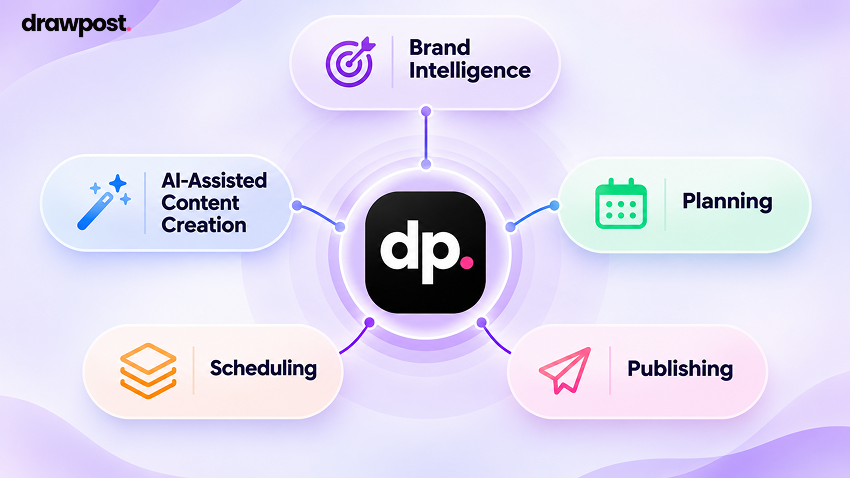
DrawPost AI brings brand intelligence, AI-assisted content creation, planning, scheduling, and publishing into one social media management platform.
Instead of starting with a generic caption prompt, teams can provide their website URL. DrawPost uses website information to help establish the brand’s audience, positioning, and identity. Users can then review the brand profile and confirm voice preferences, visual direction, and publishing requirements.
From there, the platform supports AI-generated captions and visuals, a visual content calendar, and publishing across connected channels such as LinkedIn, Instagram, Facebook, X, and YouTube.
Its Autopilot functionality can help generate and schedule upcoming content based on the configured brand profile and publishing cadence. Agencies can also maintain separate brand environments for different clients.
This approach addresses a common operational challenge: preserving brand context as content moves from planning to creation and publishing. However, automation works best when the inputs are accurate. Marketing teams should still verify product claims, review sensitive messaging, and assess whether the final content represents the brand appropriately.
The goal is to automate repetitive production work, not the judgment behind good communication.
6. Review Content Before Publishing
Even well-documented guidelines and capable automation tools won’t catch every communication issue.
A post might use the correct vocabulary but communicate an unsupported claim. Another might match the brand’s personality while overlooking the expectations of a particular audience. That’s why editorial review remains important. Reviewers should evaluate content against three questions.
Does this sound like our brand?
Check whether the writing reflects established personality traits, terminology, and messaging principles.
Does the message suit the platform and audience?
Consider whether the structure, level of detail, and tone fit the context in which people will encounter it.
Is the content accurate and aligned with our business?
Verify factual statements, product details, examples, and promotional promises. For routine posts, one designated reviewer may be sufficient. Sensitive announcements, regulated claims, and major campaigns may require input from additional stakeholders. The process should be proportionate to the risk and importance of the message.
Consistency shouldn’t create an approval bottleneck. A good review process helps teams identify meaningful issues without delaying every publication.
7. Audit Your Brand Voice and Refine It Regularly
Brand voice guidelines shouldn’t remain unchanged simply because they were approved once. Businesses introduce new products, expand into different markets, and reach new audiences. Social platforms also change how content is presented and consumed.
A regular brand voice audit helps determine whether published content still reflects the intended identity. Start with a representative sample of posts from each active channel. Include content from different contributors, campaigns, and formats.
Evaluate the sample against established criteria:
| Review Area | What to Look For |
| Brand personality | Does the content reflect the intended characteristics? |
| Message consistency | Are the company’s positioning and key messages recognizable? |
| Language and terminology | Does the content follow approved writing conventions? |
| Platform suitability | Is the tone appropriate for the audience and channel? |
| Content accuracy | Are claims, examples, and product information reliable? |
A simple rating system can help reviewers identify recurring patterns. For example, if Instagram posts consistently score lower on messaging alignment than LinkedIn posts, the team may need clearer examples for visual-first content.
Audience responses can add another perspective. Comments, questions, and engagement patterns may reveal which approaches communicate effectively. Still, engagement should not be treated as a direct measure of voice consistency. A provocative post can attract attention while working against the brand’s intended identity. Use the findings to update examples, refine guidelines, and improve contributor onboarding.
The aim is continuous alignment, not perfect uniformity.
Real-World Examples of Consistent Brand Voice Across Social Media
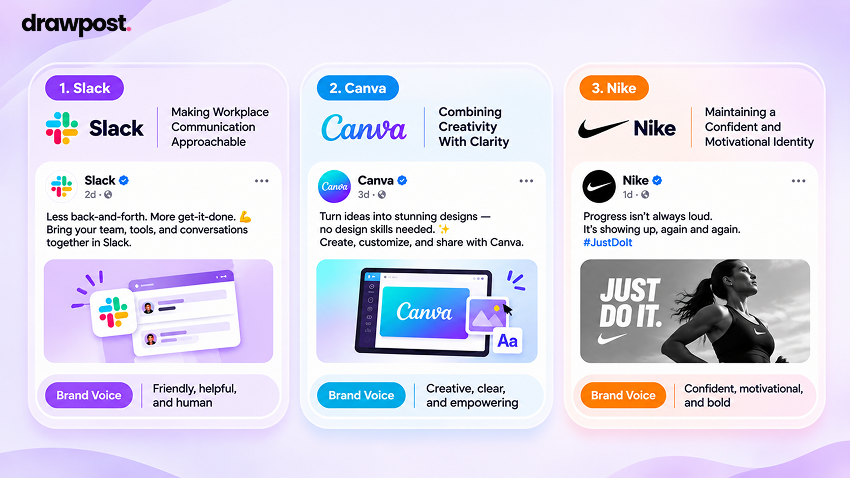
Strong brands don’t rely on identical wording to remain recognizable. They establish a distinct communication personality and carry it into different formats.
The following brands illustrate approaches that B2B marketers can learn from.
1. Slack: Making Workplace Communication Approachable
<entity value=”Slack” category=”software” disambig=”workplace communication platform”/> provides a useful example of how B2B communication can feel approachable without losing professional relevance.
Its brand positioning emphasizes making workplace communication easier and more connected. This creates room for straightforward product explanations, relatable workplace situations, and a conversational style that remains relevant to business audiences.
What B2B marketers can learn: Professional communication doesn’t need to sound formal or complicated. Clear language can make technical products easier to understand without diminishing credibility.
2. Canva: Combining Creativity With Clarity
<entity value=”Canva” category=”software” disambig=”online visual design and collaboration platform”/> communicates around creativity, accessibility, and helping people create visual content.
These themes lend themselves to product education, creative demonstrations, visual examples, and approachable messaging. The content format can change substantially while the central idea of making design accessible remains consistent.
What B2B marketers can learn: Establish a small number of recognizable messaging themes and express them through different content formats.
3. Nike: Maintaining a Confident and Motivational Identity
<entity value=”Nike” category=”brand” disambig=”sportswear and athletic footwear company”/> demonstrates the value of a clearly established brand personality.
Its long-running motivational positioning provides a recognizable foundation for athlete storytelling, product communication, and campaign messaging. Different stories may use different emotional tones, but the broader focus on achievement and athletic ambition creates continuity.
What B2B marketers can learn: A strong brand identity can connect diverse campaigns without requiring repetitive language. The common principle across these examples is that recognizable brands maintain consistent underlying ideas while allowing their content to vary in style, format, and emphasis.
Keep Your Brand Voice Consistent as Your Social Media Presence Grows
Maintaining a recognizable brand voice becomes harder when content production scales faster than the processes supporting it. Clear guidelines establish the direction. Platform-specific communication makes messages relevant. Shared workflows keep contributors aligned, while automation helps reduce repetitive work.
The strongest approach connects all these elements instead of managing them separately. For teams looking to bring that process into one place, DrawPost AI combines brand-aware content creation with planning, scheduling, and multi-platform publishing.
Frequently Asked Questions
Q. How do you maintain a consistent brand voice across social media?
Start by defining your brand’s personality, preferred language, and core messaging. Document these elements in practical guidelines, then adapt the delivery for different platforms. Shared content workflows, editorial reviews, and brand-aware automation tools can help maintain consistency as publishing demands increase.
Q. Why is brand voice consistency important on social media?
Brand voice consistency helps audiences recognize a company across different channels and interactions. For B2B organizations, it also supports credible communication throughout the buyer’s research process. Internally, consistent guidelines reduce conflicting messages and make collaboration easier for marketing teams.
Q. How do you create brand voice guidelines for social media?
Choose three or four defining personality traits, then translate them into specific writing rules. Document preferred vocabulary, messaging priorities, tone variations, and formatting conventions. Include examples of approved and off-brand content so contributors can apply the guidelines without relying on personal interpretation.
Q. How can brands maintain the same voice across different social media platforms?
Keep the brand’s core personality and messaging consistent while adapting tone, length, and format to each platform. A business might publish detailed industry insights on LinkedIn and shorter, visually driven explanations on Instagram. Both can communicate the same values and expertise.
Q. Can AI and automation tools help maintain a consistent social media brand voice?
Yes. Brand-aware AI tools can use defined voice preferences, audience information, and brand context to support content generation. Scheduling platforms can also centralize planning and publishing. However, teams should review AI-generated content for accuracy, relevance, and alignment with their established communication guidelines.
Our Latest Insights

Top 10 AI Social Media Management Tools for Agencies in 2027
Compare the 10 best AI social media management tools for agencies in 2027. Explore features, pricing, pros, cons, and solutions for managing multiple clients.

How Small Businesses Can Automate Social Media Without Hiring a Full Team
Learn how small businesses can use AI and social media automation to create content, schedule posts, and grow online without hiring a full marketing team.

Social Media Scheduling: 9 Best Practices for Brands and Agencies
Discover 9 social media scheduling best practices for brands and agencies, from content calendars and approvals to cross-platform publishing and automation.