
Table of Contents
Managing social media has become a demanding responsibility for businesses, irrespective of their size or industry. What once involved publishing occasional updates and responding to customer comments now requires regular content creation, engaging visuals, platform-specific campaigns, performance analysis, and much more.
And as businesses continue to expand their presence across multiple social platforms, keeping up with these responsibilities is becoming increasingly difficult.
But here’s something interesting.
According to HubSpot’s 2026 Social Media Marketing Report, 94% of social media marketers use AI in their workflows. The most common applications include brainstorming content ideas (42.9%), generating captions (41.5%), and creating images (38.35%).
Despite this widespread adoption, the same report found that 45% of marketers still struggle to produce high-quality content consistently.
That’s not all. HubSpot also reports that 48% of social media marketers expect their tool stacks to expand, indicating that businesses continue to look for additional ways to support their marketing operations.
These findings highlight an important distinction. Businesses are increasingly using AI, but generating a caption or image is only one part of managing an effective social media presence.
Someone still needs to plan campaigns, maintain a recognizable brand voice, prepare content for different platforms, schedule publication, and determine whether those efforts are producing meaningful results.
This is precisely where AI social media management tools come into the picture.
Unlike standalone content generators, these platforms can help businesses manage several activities within a connected workflow. Some focus on automating content creation, while others specialize in scheduling, analytics, audience engagement, or team collaboration.
However, with dozens of platforms offering similar promises, choosing the right software can be easier said than done.
So, which tools are actually worth considering for your business?
To help you make an informed decision, we’ve compiled 11 of the best AI social media management tools for 2027, comparing their features, pricing, business applications, and distinguishing capabilities.
Let’s explore what each platform brings to the table.
Best AI Social Media Management Tools at a Glance
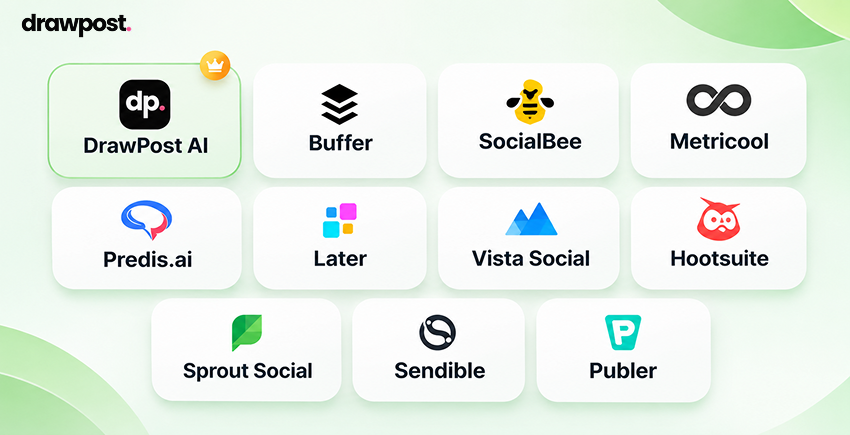
The best AI social media management tools for businesses include DrawPost AI, Buffer, SocialBee, Metricool, Predis.ai, Later, Vista Social, Hootsuite, Sprout Social, Sendible, and Publer.
While these platforms share certain capabilities, they serve different business requirements. Some are particularly useful for creating branded content, whereas others offer stronger capabilities for analytics, scheduling, or managing larger marketing teams.
Here’s a quick social media management tools comparison to help you narrow down your options.
| Tool | Best For | Starting Price |
| DrawPost AI | Brand-specific AI content creation and automation | $25/month |
| Buffer | Simple scheduling and AI writing assistance | Free; paid from $5/channel/month |
| SocialBee | AI content planning and evergreen recycling | $24.20/month, billed annually |
| Metricool | Social analytics and competitor monitoring | Free; paid from $20/month |
| Predis.ai | AI-generated images, videos, and advertisements | $24/month, billed annually |
| Later | Visual planning and content calendars | $18.75/month, billed annually |
| Vista Social | Publishing, engagement, and collaboration | $99/month |
| Hootsuite | Social listening and larger marketing operations | From $99/user/month |
| Sprout Social | Advanced reporting and customer engagement | $79/seat/month, billed annually |
| Sendible | Team collaboration and content approvals | $35/month |
| Publer | Budget-friendly scheduling and automation | Free; paid from $5/month |
How we compared these tools: We reviewed publicly documented AI capabilities, content creation features, publishing support, analytics, collaboration, and pricing structures. This is a research-based comparison, not a claim that every platform underwent hands-on testing.
11 Best AI Social Media Management Tools Compared
1. DrawPost AI: Best for Brand-Specific Content Creation and Automation
Creating one social media post isn’t particularly complicated anymore. With countless AI applications available, businesses can generate captions and images within minutes.
However, creating content consistently while keeping it relevant to your business, recognizable to your audience, and organized across multiple platforms is another matter.
Consider a growing ecommerce company that publishes product announcements, promotional campaigns, educational content, and customer-focused posts every week.
The team might rely on one application for generating captions, another for creating visuals, and a separate scheduling platform for publishing.
While each application performs its intended task, moving between them adds unnecessary steps to the content creation process.
DrawPost AI approaches this challenge by connecting brand understanding, content generation, planning, and publishing within one platform.
Instead of starting every post with a blank prompt, businesses can begin by entering their website URL. DrawPost analyzes the available business information to establish an initial brand profile, including its positioning, audience, and communication preferences.
Users can then review and refine the profile before creating content.
Once the brand context is established, DrawPost helps generate social media posts, images, carousels, and videos while providing tools to organize and schedule them.
Key Features of DrawPost AI
- AI Brand Setup: Creates an initial brand profile using your website.
- Brand Kit: Maintains visual identity and communication preferences.
- AI Content Generation: Creates captions, images, carousels, and videos.
- Content Calendar: Organizes upcoming posts and publishing schedules.
- Autopilot: Supports recurring content generation and automated scheduling.
- Multi-Brand Management: Helps teams organize content for different brands.
- Analytics and Insights: Provides performance information for published content.
How Does DrawPost Support Business Marketing?
Let’s say a fitness company wants to prepare social media content for an upcoming membership promotion. The campaign might require educational posts about its services, promotional visuals, short videos, and reminders leading up to the launch.
With DrawPost, the marketing team can work from its established brand profile, generate relevant content, arrange posts within a calendar, and schedule publication across supported channels. Instead of repeatedly explaining its brand identity to different applications, the business can keep that context connected to its content workflow.
The platform also supports publishing to connected channels such as Instagram, Facebook, LinkedIn, X, and YouTube. For growing businesses, this approach can make recurring content production more manageable while keeping campaign decisions in the hands of the marketing team.
DrawPost AI Pricing
DrawPost offers three primary subscriptions:
- Creator: $25/month with 200 AI credits.
- Starter: $49/month with 400 AI credits.
- Growth: $129/month with 2,000 AI credits and multi-client management.
Businesses can also begin with a seven-day trial offering 100 free AI credits without providing a payment card.
Why Consider DrawPost AI?
DrawPost is particularly relevant for businesses that want more than a standalone AI caption generator or basic scheduling application.
Its main advantage is connecting brand information with ongoing content creation and publication.
For small businesses, growing brands, marketing teams, and enterprises looking to reduce manual content production, DrawPost offers a practical way to manage these activities from one platform.
2. Buffer: Best for Simple Social Media Scheduling
Not every business needs an elaborate content generation system.
Some already have dedicated writers, designers, or an established creative process. Their primary challenge is organizing approved content and publishing it consistently across multiple social platforms.
If that sounds familiar, Buffer is worth considering.
Buffer focuses on making social media scheduling straightforward. Its publishing dashboard allows businesses to organize posts, maintain content queues, and manage their activity across connected accounts.
The platform also includes an AI Assistant that helps generate ideas, rewrite captions, and adapt existing content for different platforms.
For example, a consulting firm might prepare a detailed LinkedIn post and use Buffer to develop shorter variations for other channels.
Rather than creating an entirely new campaign, the team can repurpose its existing material.
Notable Features
- AI-assisted caption writing and editing
- Multi-platform publishing calendar
- Content ideas and draft management
- Automated posting queues
- Performance analytics and insights
- Collaboration and approvals on the Team plan
Pricing: Free plan available. Essentials starts at $5 per channel monthly, while Team starts at $10 per channel monthly, both billed annually.
3. SocialBee: Best for AI Content Planning and Evergreen Recycling
Ever published a useful social media post only to forget about it a few weeks later?
Well, you’re certainly not the only one.
Businesses often spend considerable time developing educational posts, product explanations, industry insights, and customer FAQs. Much of this content remains relevant long after its original publication date.
Yet, without a structured system, valuable material gets buried beneath newer posts.
SocialBee helps businesses address this problem through category-based scheduling and evergreen content recycling.
Its platform allows marketers to organize posts into different categories, establish publishing schedules, and reuse content when appropriate.
SocialBee also offers an AI Copilot that assists with planning strategies and preparing content.
What SocialBee Offers
- AI Copilot for social media planning
- AI-generated captions and images
- Category-based content organization
- Evergreen content recycling
- Multi-platform scheduling
- Analytics and post approvals on eligible plans
Pricing: Bootstrap starts at $24.20/month, Accelerate at $40.80/month, and Pro at $82.50/month, billed annually.
4. Metricool: Best for Analytics and Competitor Monitoring
Let’s face it.
Publishing more content doesn’t necessarily mean your business is getting better marketing results.
A post might receive thousands of impressions without generating a single meaningful customer enquiry. Meanwhile, another post with relatively modest reach could attract visitors who are genuinely interested in your services.
Understanding this difference is essential.
Metricool is designed for businesses that want better visibility into their social media performance.
It combines scheduling, analytics, competitor monitoring, and AI assistance within one dashboard.
The platform enables marketers to examine account performance, compare content activity, and prepare reports without relying entirely on separate analytics tools.
Key Capabilities
- Cross-platform social media analytics
- Competitor account monitoring
- AI caption and content assistance
- Social media scheduling
- Performance reporting
- Team management on advanced plans
Pricing: Free plan available. Starter begins at $20/month, while Advanced starts at $53/month.
5. Predis.ai: Best for AI-Generated Images and Videos
Writing social media captions has become considerably easier with generative AI.
But producing the visuals that accompany those captions is often where the real work begins.
A product announcement may require several graphic variations. A promotional campaign might need carousels, short videos, and advertising creatives for different platforms.
For businesses without extensive design resources, these requirements can consume a substantial amount of time.
Predis.ai focuses on AI-assisted visual content production.
The platform helps businesses generate social media images, videos, carousels, and promotional creatives using AI.
It also provides publishing capabilities and competitor analysis, depending on the selected plan.
Major Features
- AI-generated social media graphics
- Carousel and video generation
- Product-focused advertising creatives
- AI caption and hashtag generation
- Competitor content analysis
- Scheduling and automatic publishing on eligible plans
Pricing: Core starts at $24/month, Rise at $55/month, and Enterprise+ at $212/month, billed annually at advertised promotional rates.
6. Later: Best for Visual Social Media Planning
Some businesses can prepare their entire social media calendar using a spreadsheet.
Others need to see how their posts will appear together before anything goes live.
Think of fashion labels, beauty companies, hotels, and lifestyle brands where visual presentation plays an important role in customer perception.
Later is designed around this type of content planning.
Its visual calendar allows marketers to arrange upcoming posts, manage media assets, and coordinate publishing across supported social channels.
Later also includes AI assistance for generating content ideas and captions.
Notable Features
- Visual content calendar
- AI caption and idea generation
- Multi-platform scheduling
- Recommended publishing times
- Social media analytics
- Team collaboration on higher plans
Pricing: Starter begins at $18.75/month, Growth at $37.50/month, and Scale at $82.50/month, billed annually.
7. Vista Social: Best for Publishing and Customer Engagement
Creating social media content is one responsibility. Managing what happens after publication is another.
Customers may leave comments, ask questions, send messages, or post reviews across different platforms.
When several employees handle these interactions, keeping everything organized can become challenging.
Vista Social combines social media publishing, engagement management, analytics, and collaboration in one platform.
Its AI capabilities support content generation, response drafting, and selected workflow activities.
The platform also offers tools for organizing conversations and coordinating responsibilities between team members.
Key Features
- AI-generated captions and responses
- Social media publishing and scheduling
- Unified inbox for customer engagement
- Review and reputation management
- Team collaboration and approvals
- Analytics and performance reporting
Pricing: Professional starts at $99/month, Advanced at $199/month, and Scale at $449/month.
8. Hootsuite: Best for Larger Social Media Operations
As businesses expand, social media management often becomes a shared responsibility.
Marketing teams handle campaigns, customer service employees respond to enquiries, and managers review performance reports.
Meanwhile, someone needs to monitor conversations about the business and identify issues that could affect its reputation.
Simple scheduling software may no longer be sufficient for these requirements.
Hootsuite is designed to support broader social media operations.
Its platform connects publishing, analytics, social listening, audience engagement, and AI-assisted workflows.
Hootsuite’s AI assistant, Wisdom, helps users work with social data, generate content, and obtain insights using natural-language instructions.
Notable Capabilities
- AI-assisted content and image generation
- Cross-platform publishing calendars
- Social listening and sentiment analysis
- Unified engagement inbox
- Performance and competitor reporting
- Team access and approval workflows
Pricing: Standard starts at $99/user/month, Professional at $199/user/month, and Advanced at $399/user/month. Enterprise pricing is customized.
9. Sprout Social: Best for Advanced Reporting and Analytics
What if your social media data could tell you more than which post received the most likes?
Customer conversations, recurring questions, audience sentiment, and engagement patterns can provide useful information about how people perceive your business.
However, interpreting these signals becomes difficult when large volumes of activity are spread across different networks.
Sprout Social helps businesses manage social publishing, customer engagement, analytics, and AI-supported insights.
Its reporting capabilities are particularly relevant for organizations that use social media information to support marketing and customer experience decisions.
Key Capabilities
- Advanced social analytics and reporting
- AI-assisted insights through Trellis
- Social media publishing and planning
- Customer engagement management
- Competitor and audience analysis
- Social listening through additional solutions
Pricing: Essentials starts at $79/seat/month, Standard at $199, Professional at $299, and Advanced at $399, with annual billing.
10. Sendible: Best for Content Approvals and Collaboration
Ever had a social media post delayed because nobody knew who was responsible for approving it?
For businesses with several content contributors, these situations are surprisingly common.
A writer prepares the caption. A designer creates the visual. A marketing manager requests changes. And by the time the content is approved, the original publishing deadline has passed.
Sendible helps organize collaborative social media workflows.
The platform combines scheduling, content approvals, separate workspaces, reporting, and audience engagement tools.
It also provides AI assistance for generating and editing content.
Notable Features
- AI-assisted writing and content editing
- Multi-platform publishing
- Separate brand or client workspaces
- Content assignment and approvals
- Bulk scheduling
- Social reporting and engagement management
Pricing: Core starts at $35/month, Plus at $99/month, Premium at $199/month, and Elite at $299/month.
11. Publer: Best for Affordable Social Media Publishing
Not every business needs a sophisticated marketing platform costing hundreds of dollars every month.
For smaller teams, the priority may simply be maintaining an organized publishing schedule without adding unnecessary software expenses.
Publer offers an accessible approach to social media scheduling and automation.
The platform combines publishing tools, AI assistance, recurring content features, and analytics depending on the selected subscription.
Key Features
- AI-assisted content writing
- Multi-platform scheduling
- Recurring content automation
- Publishing calendars
- Social analytics on Business plans
- Workspace and team management
Pricing: Free plan available. Professional starts at $5/month and Business at $10/month, with account-based pricing.
Which AI Social Media Management Tool Fits Your Business?
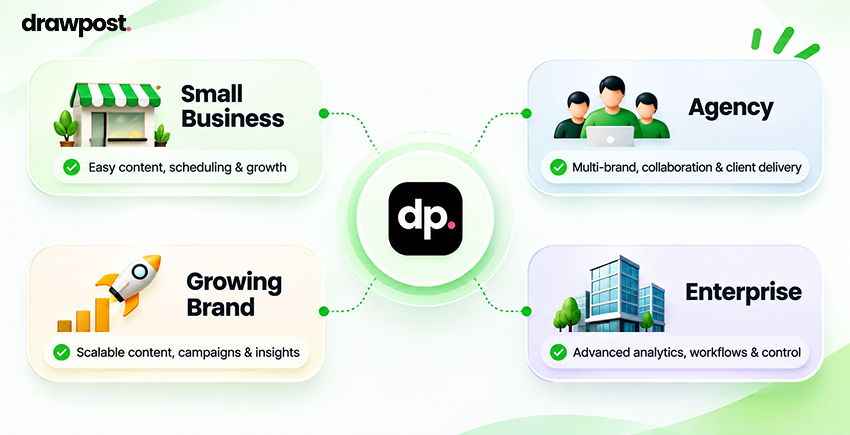
Now that we’ve explored the platforms, let’s address the question that matters most.
Which one should your business actually choose?
Well, the answer depends on what your marketing team needs help with.
A business struggling to create content every week has different requirements from one that already produces high-quality material but finds scheduling difficult.
Likewise, an organization managing customer conversations across multiple networks may prioritize engagement features over AI-generated visuals.
Here’s how the tools compare across common business requirements.
| Business Requirement | Tools to Consider | Why |
| Automating branded content creation | DrawPost AI | Connects brand setup, AI content, planning, and publishing |
| Scheduling content already prepared | Buffer, Publer | Focus on accessible publishing workflows |
| Recycling educational or evergreen posts | SocialBee | Category-based planning and content reuse |
| Producing promotional images and videos | Predis.ai | AI-focused visual asset creation |
| Planning visually coordinated campaigns | Later | Visual calendar and media organization |
| Monitoring performance and competitors | Metricool | Analytics and reporting capabilities |
| Managing customer engagement | Vista Social, Hootsuite | Inbox and engagement management |
| Advanced marketing intelligence | Sprout Social | Reporting, analytics, and customer insights |
| Coordinating several content reviewers | Sendible | Workspaces, approvals, and collaboration |
When Does an Integrated AI Platform Make More Sense?
Consider two businesses.
The first has an established creative team that prepares content in advance. Its main requirement is a reliable way to organize and publish those posts.
A scheduling-focused application may be sufficient.
The second business has limited resources for preparing captions, graphics, and campaign content. Its employees repeatedly move between different applications before a post is ready.
For this business, an integrated AI social media management platform may offer greater practical value.
That’s the type of workflow DrawPost is designed to support.
By connecting brand information, content generation, and publishing, businesses can reduce the number of separate steps involved in maintaining their social media presence.
For organizations exploring automation more broadly, our guide on social media automation for small businesses explains how to organize recurring marketing activities without building an unnecessarily complicated tool stack.
What Should Businesses Check Before Choosing a Tool?
A long feature list can look impressive. But it doesn’t necessarily tell you whether a particular platform will improve your daily operations.
Before investing in AI social media management software, there are six considerations worth examining.
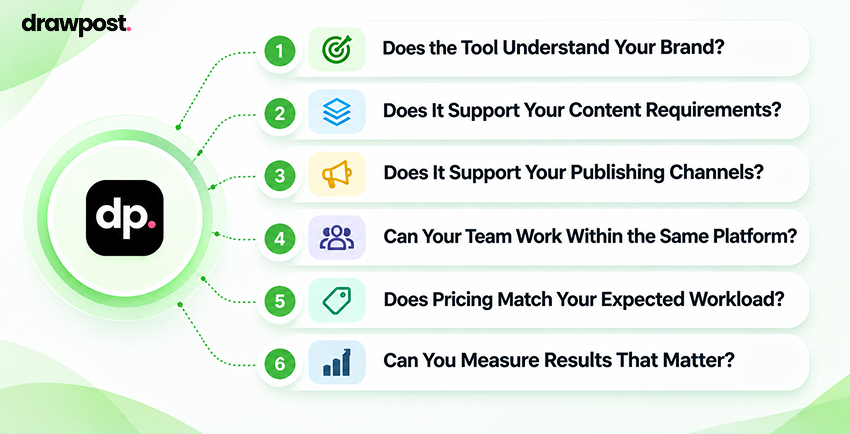
1. Does the Tool Understand Your Brand?
Generic captions can be produced using almost any AI writing application.
The more important question is whether the platform can work with your brand information, audience preferences, and communication guidelines.
Look for features that help maintain a consistent brand voice across different content formats.
Test the system using your actual products, services, and messaging rather than generic prompts.
2. Does It Support Your Content Requirements?
Businesses publish different types of content.
A professional services company may prioritize educational LinkedIn posts, whereas an ecommerce retailer might need promotional graphics, carousels, and short videos.
Check whether the platform supports the formats your business regularly produces.
Also distinguish between AI tools that generate creative assets and those that primarily assist with rewriting or scheduling them.
3. Does It Support Your Publishing Channels?
Not every application offers identical publishing functionality across social networks.
Certain content formats, account types, or interactive features may require additional steps.
Before choosing an AI social media scheduling tool, verify whether it supports the channels and post formats your business actually uses.
For businesses managing several accounts, centralized scheduling and separate brand settings can be particularly valuable.
4. Can Your Team Work Within the Same Platform?
If several people participate in content production, consider how the software handles approvals, permissions, and collaboration.
A business with one marketing employee may not need advanced workflow management.
A larger department coordinating writers, designers, reviewers, and regional teams will have different priorities.
Choose a platform that matches your operational structure rather than paying for collaboration features your team won’t use.
5. Does Pricing Match Your Expected Workload?
Subscription costs can increase for different reasons.
Some vendors charge per connected channel. Others charge per user, brand, or workspace.
AI generation platforms may also calculate usage through credits.
Before subscribing, estimate how many posts, visuals, videos, accounts, and users your business expects to manage each month.
For example, Buffer’s Essentials plan starts at $5 per channel monthly when billed annually. A business connecting eight channels would therefore pay approximately $40 per month before any additional services.
That example doesn’t imply equivalent functionality across products. It simply shows why total usage matters more than an advertised entry price.
6. Can You Measure Results That Matter?
A useful tool should help your team evaluate content performance in relation to its marketing objectives.
For some businesses, engagement and audience growth may be important indicators.
Others may prioritize website visits, product enquiries, bookings, or customer engagement.
Choose reporting capabilities that help employees make decisions rather than simply collecting additional statistics.
This becomes especially important during seasonal campaigns.
For instance, a Black Friday social media strategy requires coordinated promotional content, publishing deadlines, and performance monitoring. The right tools should help manage those activities without obscuring the business objective.
Final Thoughts: Choosing the Right AI Social Media Tool
There’s certainly no shortage of AI-powered social media management tools available to businesses.
From basic caption assistance to automated content creation, social scheduling, analytics, and audience engagement, these platforms can support different parts of your marketing operations.
However, no single application is the right choice for every business.
Buffer and Publer offer accessible publishing workflows. SocialBee supports recurring content strategies, while Predis.ai focuses on AI-generated visual assets.
Metricool is worth considering for analytics, and Later provides useful visual planning capabilities.
Businesses with more complex engagement and reporting requirements can explore Hootsuite, Sprout Social, Vista Social, and Sendible.
But what if your biggest challenge isn’t scheduling the content? What if it’s creating relevant, on-brand posts consistently in the first place?
That’s where DrawPost AI offers a compelling approach.
Rather than treating content creation and publishing as separate activities, DrawPost connects your brand information with AI content generation, a visual calendar, and automated publishing.
For growing businesses and marketing teams, this can make recurring social media content production considerably more manageable.
After all, the goal isn’t simply to publish more posts.
It’s to maintain a useful, recognizable social media presence while giving your team more time to focus on campaign decisions, customer relationships, and business growth.
Ready to Simplify Your Social Media Management?
DrawPost AI brings brand-specific content creation, campaign planning, and social media publishing into one connected platform.
Frequently Asked Questions
Q. What Are the Best AI Social Media Management Tools in 2027?
Some of the best AI social media management tools for 2027 include DrawPost AI, Buffer, SocialBee, Metricool, Predis.ai, Later, Hootsuite, Sprout Social, Vista Social, Sendible, and Publer. Each serves different business requirements. DrawPost focuses on branded content creation and automation, Buffer supports straightforward scheduling, and Metricool specializes in analytics. Businesses should compare their publishing needs, marketing resources, and budgets before selecting a platform.
Q. How Much Do AI Social Media Management Tools Cost?
AI social media management tools range from free plans to enterprise subscriptions costing hundreds of dollars monthly. Basic scheduling applications may start around $5 per channel, while platforms offering AI content generation, collaboration, and advanced reporting generally cost more. Total expenses depend on connected accounts, users, workspaces, and AI credits. Businesses should examine the complete pricing structure and estimated monthly usage before purchasing.
Q. Which AI Social Media Management Tool Is Best for Businesses?
The best platform depends on your business’s marketing priorities. DrawPost AI is worth considering when brand-specific content generation and publishing automation are important. Buffer supports simple scheduling, Metricool focuses on analytics, and Hootsuite provides broader social media operations. Before choosing, identify whether content creation, publishing, audience engagement, or reporting consumes the most time and select software that addresses that requirement.
Q. Can AI Social Media Management Tools Automate Content Creation and Publishing?
Yes, several AI social media management tools can assist with generating content, organizing publishing calendars, and scheduling posts across supported networks. Some platforms also provide automation based on brand information and publishing preferences. However, businesses should still review AI-generated content for factual accuracy, brand consistency, and promotional compliance. Automation works best when employees retain control over marketing decisions and customer-facing communications.
Our Latest Insights

How to Manage Multiple Client Social Media Campaigns During the Holidays
Discover how marketing agencies can streamline multiple client social media campaigns during the holidays with workflows, batching, and automation tools.
In-House vs. Outsourced Social Media Management vs. AI Tools: Which Is More Cost-Effective?
Compare in-house vs. outsourced social media management and AI tools. Explore costs, pricing, ROI, and how to choose the most cost-effective approach.

Christmas Social Media Marketing Ideas for Businesses in 2026
Explore practical Christmas social media marketing ideas for businesses in 2026, including content, campaigns, deadlines, platforms, and measurement.