In-House vs. Outsourced Social Media Management vs. AI Tools: Which Is More Cost-Effective?
Table of Contents
Your social media calendar is packed. The next campaign is approaching, your designer has three pending requests, and the marketing team is still working on posts that should have gone live last week.
Sound familiar?
At this point, most businesses consider one of three options: hire a dedicated social media manager, hand the work to an agency, or bring AI into the process.
Each comes with an attractive promise. An internal employee understands your business. An agency brings specialist experience. AI tools can produce and organize content at a fraction of the usual software and service costs.
And that’s where the real dilemma begins.
A social media manager in the U.S. can earn over $100,000 annually, according to Salary.com. Meanwhile, agency engagements can cost several thousand dollars per month, and AI software subscriptions often begin at much lower prices.
But are these options really comparable?
After all, paying less to publish content means little if your campaigns miss the mark or your team spends hours correcting what was supposed to save time.
This guide breaks down In-house vs outsourced social media management vs AI tools, examines the real cost of AI-assisted workflows, and shows how businesses can choose an approach that makes financial sense without compromising their marketing objectives.
Key Takeaways
- In-house social media management provides dedicated ownership, but employee compensation and operating expenses increase the investment.
- Outsourcing gives businesses access to specialist capabilities without hiring multiple employees, although costs depend heavily on scope.
- AI social media management tools reduce certain content production expenses but still require human direction and approvals.
- Comparing monthly subscriptions against salaries does not reveal the actual cost of running a social media operation.
- Agencies and enterprises can benefit from AI-assisted workflows alongside internal teams and external specialists.
- The most economical approach is the one that delivers the required content quality and business results at a sustainable total cost.
How Much Does In-House Social Media Management Cost?
Let’s begin with the traditional approach: building an internal team.
For a business with several active social channels, hiring someone who understands the brand and coordinates directly with internal departments can be appealing.
A dedicated manager knows when a product is launching, which campaigns need attention, and how customers typically respond. There’s no need to repeatedly brief an external agency on everyday company developments.
The advantage is obvious. But so is the financial commitment.
The Cost of Hiring a Social Media Manager
According to Salary.com’s U.S. salary research, the average annual salary for a social media manager was $112,760 as of August 2026.
That’s approximately $9,397 per month in base salary alone.
The figure is a national estimate for the job title, not a fixed hiring rate. Actual compensation varies with experience, location, company size, and responsibilities.
There’s another expense employers need to consider.
The U.S. Bureau of Labor Statistics reported that benefits represented 30% of total private-industry compensation costs in June 2026, while wages and salaries accounted for 70%.
This doesn’t mean every business should simply add 30% to an employee’s salary. The figures describe the average composition of total employer compensation across private industry.
Still, they demonstrate why the amount stated in an employment offer rarely reflects the full expense.
An internal social media operation may also require design subscriptions, scheduling software, equipment, training, and occasional production assistance.
What Goes Into the Monthly Operating Budget?
Consider the responsibilities involved in maintaining several active channels.
Someone must develop content ideas, write captions, prepare visuals, coordinate approvals, schedule posts, monitor engagement, and report results.
An experienced manager may handle several of these tasks independently. Others require a designer, video editor, paid media specialist, or additional support.
The social media team operating costs therefore depend on both the employee’s responsibilities and the volume of content being produced.
A company publishing a few posts each week may not use the employee’s full capacity. By contrast, a consumer brand managing daily campaigns and customer conversations could justify several dedicated roles.
When Does an In-House Team Make Financial Sense?
Here’s a situation worth considering.
An eCommerce brand launches new collections every month. Its marketing activities depend on constant coordination with product teams, customer support, and sales.
In this case, an internal social media manager can respond quickly to changing priorities and stay involved in campaign decisions.
Now consider a professional services business publishing twelve educational posts monthly. A full-time hire may be difficult to justify if social media represents only a small portion of its marketing workload.
The same expense can make sense for one organization and be excessive for another.
And that’s precisely why many businesses turn to outsourcing.
Is Outsourcing Social Media Management Actually Cheaper?

Hiring an agency offers a different financial arrangement.
Instead of committing to a permanent employee, the company pays for an agreed scope of marketing services.
Depending on the provider, that scope may cover content strategy, creative production, publishing, community management, and reporting.
The attraction is access to several capabilities without recruiting a specialist for each one.
But how much does that access cost?
What Do Social Media Agencies Charge?
According to Clutch’s Social Media Marketing Pricing Guide, the average social media marketing project in its reviewed dataset costs approximately $61,148.53, with an average duration of twelve months.
That works out to around $5,107.28 per month.
Clutch also reports hourly rates of $25 to $49 across many listed social media marketing services.
These figures are useful benchmarks. They’re not universal prices or quotations for identical service packages.
A local business contracting an agency for basic posting may pay substantially less than an enterprise requiring original campaigns, video production, paid advertising, and detailed performance analysis.
The important question isn’t simply how much an agency charges.
It’s what the business receives in return.
What Does the Agency Retainer Really Include?
Consider two proposals.
Agency A offers twelve posts a month, basic visuals, and scheduled publishing. Agency B provides content planning, original creative work, community support, and monthly performance recommendations.
Even if their retainers were similar, the value could be entirely different.
Before committing, businesses should examine the following expenses:
- Strategy and planning: Research, campaign calendars, and channel recommendations.
- Content production: Copywriting, design, video editing, and revisions.
- Publishing and monitoring: Scheduling, community management, and account activity.
- Paid campaign support: Advertising management and separate media spend.
- Performance reporting: Analytics, recommendations, and client meetings.
- Additional requests: Urgent campaigns, extra assets, and out-of-scope work.
These are the areas where social media outsourcing expenses can grow beyond the initial quotation.
An inexpensive retainer isn’t necessarily a bargain if your internal team must complete much of the unfinished work.
Where Outsourcing Has an Advantage
Let’s take a B2B technology company preparing to launch a product in the U.S.
The company needs LinkedIn thought leadership, product visuals, campaign messaging, and social performance reporting. Hiring full-time employees for each responsibility would create a considerable fixed expense.
A specialist agency could provide the required skills through one engagement.
The business still needs someone internally to explain the product and approve messaging, but it doesn’t have to maintain an entire creative department.
There is a trade-off, though.
External teams depend on information supplied by their clients. Delayed approvals, unclear briefs, and changing priorities can disrupt the content schedule.
Outsourcing reduces certain staffing responsibilities. It doesn’t eliminate the need for internal coordination.
Now, with AI becoming part of everyday marketing operations, there’s a third option worth examining.
Can AI Social Media Management Tools Reduce Expenses?
Think about the amount of time spent turning one marketing idea into several finished posts.
A campaign brief becomes a LinkedIn update. The same message is adapted for Instagram. Someone writes shorter captions, prepares visual assets, and organizes everything in the publishing calendar.
The process is familiar to practically every social media team.
And much of it involves repeatable work.
This is where AI-powered social media automation can make a difference.
AI tools can help generate content ideas, draft platform-specific captions, prepare creative variations, and organize publishing workflows. The exact capabilities depend on the software.
The direct subscription cost is often considerably lower than the cost of hiring an employee or contracting an agency.
For instance, Buffer’s official pricing page lists its Essentials plan at $5 per channel per month when billed annually. Its Team plan starts at $10 per channel per month under the same billing structure.
That makes software accessible even when the business manages several accounts.
However, social media management tools pricing tells only part of the story.
The Work AI Can Handle and the Work It Cannot
Suppose a marketing team needs to repurpose a product article into ten social posts.
AI can help prepare several captions and creative variations. It may also assist with organizing approved content for publication.
What it cannot automatically guarantee is that the messaging reflects the company’s latest priorities or that each post communicates something worth reading.
A financial services company publishing an investment-related message still requires appropriate review. A consumer brand announcing a limited-time offer needs someone to confirm prices, dates, and availability.
The distinction is important.
Software can assist with execution, while the business remains responsible for the quality and accuracy of its communication.
This applies to agencies and large organizations just as much as it does to smaller brands.
Where AI Becomes Valuable at Scale
Imagine an agency managing fifteen client accounts.
Each client needs a distinct voice, different content themes, and a separate publishing schedule. Preparing content manually across every account creates substantial coordination work.
AI-assisted creation can help the agency prepare initial content and organize recurring production, leaving account managers more time for reviews and client communication.
An enterprise marketing team faces a comparable challenge across regions, brands, or product divisions.
A shared content system can reduce duplicated preparation work. However, larger teams also need approval procedures, access controls, and accurate separation of brand information.
AI software can support these requirements where the product offers the relevant features. It shouldn’t be assumed that every low-cost tool supports complex enterprise workflows.
So, while AI can reduce the labor involved in certain tasks, its financial value ultimately depends on the time it actually saves and the additional work the organization still needs to perform.
In-House, Agency, or AI: Which Model Is More Cost-Effective?
We’ve looked at the expenses behind each approach. The next step is to consider the value of the work being performed.
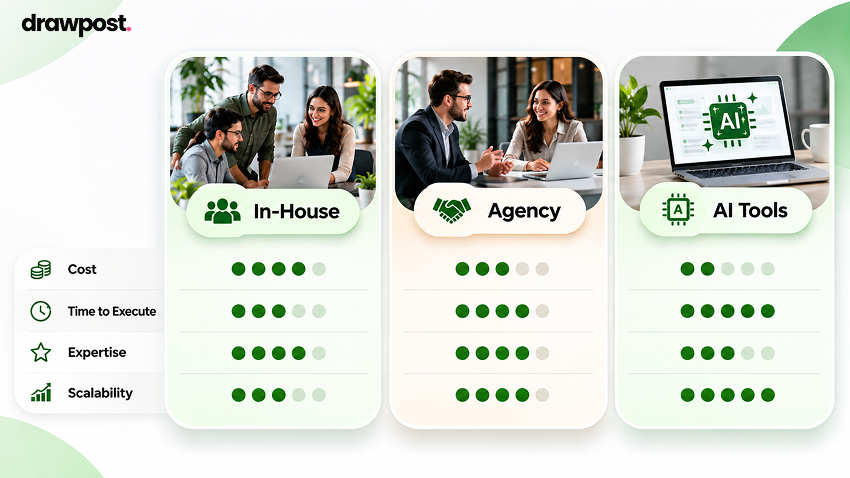
An internal employee provides daily availability and company knowledge. An agency offers specialist experience through a defined engagement. AI software assists with production and workflow tasks, but somebody must operate and supervise it.
These differences matter because the cheapest monthly payment may not represent the lowest total cost.
Compare the Models Before Comparing the Prices
| Evaluation factor | In-house team | Outsourced agency | AI-assisted team |
| Main expense | Employee compensation | Service retainer | Software plus human time |
| Brand familiarity | Direct and continuous | Developed through collaboration | Depends on inputs and reviews |
| Creative expertise | Depends on employees hired | Depends on agency team | Depends on the people using AI |
| Ability to scale output | Requires available staff capacity | Depends on contract and resources | Depends on subscriptions and review capacity |
| Strategic ownership | Internal | Shared or outsourced | Remains with internal or agency team |
| Human approval | Internal | Shared with client | Still required |
| Most useful when | Social media needs dedicated ongoing attention | Specialist execution is needed | Repeatable production work is substantial |
That table answers one part of the question. But financial decisions require actual numbers.
Let’s examine a realistic planning scenario.
A Monthly Cost Comparison for 20 Social Posts
Assume a U.S. company needs twenty posts per month across three channels. The work includes planning, content preparation, scheduling, and basic reporting.
Paid advertising and major video production are excluded to keep the scope reasonably consistent.
| Cost component | In-house | Agency | AI-assisted |
| Monthly salary/service/labor | $9,397 | $5,107 | $1,400 |
| Illustrative employer allowance | $1,879 | — | — |
| Additional software | $100 | Included* | $49 |
| Internal agency oversight | — | $175 | — |
| Total monthly cost | $11,376 | $5,282 | $1,449 |
| Cost per post | $568.80 | $264.10 | $72.45 |
Agency software is assumed included for this scenario.
Assumptions behind the comparison:
The in-house example uses Salary.com’s U.S. salary benchmark plus a hypothetical 20% employer-cost allowance and $100 in software.
The agency example uses Clutch’s published monthly project average, plus five hypothetical client-review hours at $35 per hour.
The AI-assisted example assumes forty hours of internal work at $35 per hour and a $49 monthly software subscription.
These are illustrative budgets. They are not quotes for equivalent staffing capacity or guaranteed outputs.
And there’s another qualification worth remembering.
Charging a full-time employee’s salary against only twenty posts makes the in-house cost per post look particularly high. If that person is also responsible for campaigns, customer communication, and other marketing activities, their expense should be allocated across all the work they perform.
What the Numbers Tell Us
The AI-assisted arrangement has the lowest modeled cost, but that doesn’t make it automatically appropriate for every business.
It works in the scenario because the organization already has someone capable of planning and reviewing the content.
If the company needs an experienced strategist, original professional video production, and daily community management, the software subscription won’t cover those requirements.
Likewise, an agency may offer greater value if its specialist work achieves results that a smaller internal team cannot match.
Ultimately, the point of a cost comparison of social media agencies and AI management tools is to understand where money is being spent, not to declare one delivery model universally superior.
How Should Businesses Measure Social Media ROI?
Let’s face it. Twenty low-cost posts aren’t valuable simply because they’re inexpensive.
If the content reaches the wrong audience, produces little meaningful engagement, or fails to support the business’s objectives, the apparent savings become less impressive.
This is where many cost comparisons fall short.
They calculate the price of creating content without considering what the content accomplishes.
Start With Cost per Social Media Post
The calculation is straightforward:
Cost per post = Total monthly content-related expense ÷ Number of published posts
If a company spends $3,000 on twenty posts, its average production cost is $150 per post.
But that number needs context.
A researched executive LinkedIn post may require more work than a short promotional caption. A custom video may involve scripting, filming, and editing.
Treating all formats as equivalent can lead businesses to optimize for output volume rather than useful content.
Then Measure the Outcomes That Matter
For an eCommerce business, social media may support purchases and repeat customers. A B2B organization may care more about qualified inquiries and sales conversations.
An agency could justify a higher fee if it delivers stronger creative execution and contributes to the desired outcomes.
An internal team may be valuable because it handles customer communication beyond its publishing responsibilities.
An AI-assisted workflow may be attractive because it helps the team maintain output while spending fewer hours on repetitive preparation.
The relevant measures might include engagement quality, qualified website traffic, lead generation, attributable revenue, or production hours.
The important part is choosing metrics that reflect what the business expects social media to accomplish.
When Should You Hire, Outsource, or Use AI?
At this stage, the decision becomes more practical.
Think about the work your organization performs every month and the skills required to complete it.
Choose an in-house team when social media requires constant coordination with internal departments, direct customer interaction, or frequent campaign changes. Dedicated employees are particularly useful when their responsibilities extend beyond posting.
Choose an agency when the organization lacks specialist creative or strategic capabilities. Outsourcing can also help businesses test new channels or run demanding campaigns without expanding permanent headcount.
Choose an AI-assisted workflow when existing employees or agency teams already possess the necessary marketing expertise but spend considerable time preparing content.
And if none of those options feels quite right?
A hybrid approach may be worth considering.
An enterprise marketing department could retain strategic and approval responsibilities internally, use AI for routine content preparation, and contract agencies for major campaigns.
An agency could use AI to manage repetitive client production while keeping strategists, editors, and designers responsible for the finished work.
The right combination depends on which activities truly require specialist judgment.
Where DrawPost Fits Into the Cost Equation
By now, one point should be clear. Businesses don’t necessarily need to replace their social media teams to reduce operating expenses.
Sometimes, the better opportunity is to change how those teams work.
Consider the repeated effort involved in preparing content across several brands or business units. Each one needs suitable captions, visuals, an organized calendar, and a consistent voice. The more accounts a team manages, the more coordination this creates.
DrawPost AI is one option for bringing those activities into the same workflow.
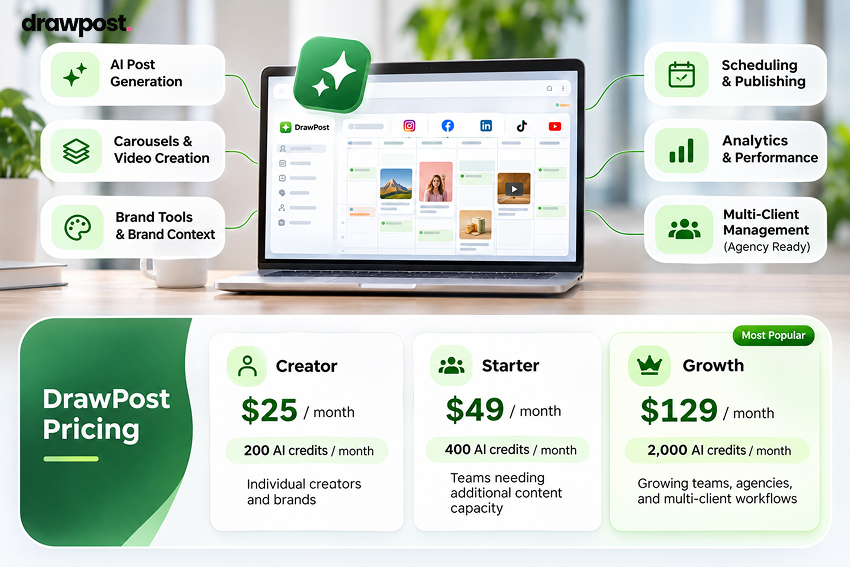
The platform combines AI post generation, carousels and video creation, brand-related tools, scheduling, publishing, and analytics. Its agency-focused offering also describes separate client brand contexts and multi-client management.
That makes it relevant to creators and growing businesses, but also to marketing agencies and enterprise teams managing multiple brands or accounts. For larger organizations, the suitability of its access, approval, integration, and governance features should still be evaluated against internal requirements.
Now, let’s look at the actual subscription expense.
How Much Does DrawPost Cost?
According to DrawPost’s official pricing, the platform currently offers three paid plans.
| DrawPost plan | Monthly price | Included AI credits | Intended use |
| Creator | $25 | 200/month | Individual creators and brands |
| Starter | $49 | 400/month | Teams needing additional content capacity |
| Growth | $129 | 2,000/month | Growing teams, agencies, and multi-client workflows |
The platform also advertises 100 free credits for seven days without requiring a credit card.
For perspective, a $129 monthly subscription amounts to $1,548 annually. That’s only the software expense, of course. It excludes the marketers and reviewers using it.
Still, when compared with the employee and agency cost benchmarks discussed earlier, the subscription represents a comparatively small portion of a social media operating budget.
The more meaningful question is whether it saves enough employee time, reduces duplicated content work, or replaces existing software expenses to justify the cost.
What Would DrawPost Cost Across Multiple Clients?
Consider an agency handling five client accounts.
DrawPost’s agency page describes its Growth plan as supporting up to five clients at $129 per month. Under that allowance, the subscription works out to approximately $25.80 per client monthly when allocated evenly across all five accounts.
That calculation is based on platform subscription cost alone. It does not include account management, strategy, content approvals, or other agency services.
Even so, it shows how software expenditure can be distributed across several clients rather than evaluated only as an individual subscription.
For enterprise teams managing several brands, the same principle applies: software economics improve when repeatable workflows can be managed centrally without compromising brand-specific review requirements.
The Larger Cost Comparison
Here’s how the three established management options and DrawPost fit together.
| Option | Published price reference | Additional expenses to consider |
| In-house manager | $112,760/year in base salary | Benefits, software, recruitment, creative resources |
| Social media agency | $5,107/month average reviewed project | Internal oversight, excluded deliverables, media spend |
| General social scheduling tool | Buffer from $5/channel/month, billed annually | Content creation, strategy, approvals, team requirements |
| DrawPost AI | 25–129/month | Human editor, reviews, additional services if needed |
Pricing sources: Salary.com, Clutch, Buffer, and DrawPost.
The figures serve different purposes and shouldn’t be interpreted as equivalent service packages.
An employee or agency can assume operational responsibilities. A software product provides capabilities that people use to perform their work.
For organizations already investing in social media talent, the opportunity is to make that investment more productive.
And that’s where a platform like DrawPost can fit naturally into the decision.
Need a More Efficient Content Workflow?
See how DrawPost supports social content creation and publishing across brands and client accounts.
Final Thoughts: Spend on Expertise, Save on Repetitive Work
So, which is more cost-effective: an in-house social media team, an external agency, or AI tools?
The answer depends on what your organization expects social media to achieve.
Hiring internally makes sense when continuous brand involvement and operational control are essential. Outsourcing can deliver specialist capabilities without creating permanent positions. AI can reduce the effort required for repeatable content production, particularly when skilled marketers remain involved.
For many organizations, the strongest solution may be a combination of all three.
An internal team sets direction. Agencies contribute expertise where needed. AI supports work that doesn’t require the same level of manual effort every time.
Before committing to a larger social media marketing budget, identify what your people should own, which activities benefit from external expertise, and where software can reduce unnecessary production costs.
That’s a more useful financial decision than simply choosing the lowest monthly price.
Frequently Asked Questions
Q. Is it cheaper to outsource social media management or hire an in-house team?
Outsourcing can cost less when a business needs a defined collection of services rather than dedicated full-time staff. Clutch’s reviewed-project average is approximately $5,107 monthly, while Salary.com’s social media manager salary estimate exceeds $9,000 monthly before employer expenses. However, these figures represent different service scopes. Compare actual deliverables, internal oversight, and staffing requirements before deciding which option is more economical.
Q. How much does an in-house social media manager cost?
Salary.com’s August 2026 estimate places the average U.S. social media manager salary at $112,760 annually. Employers should also consider benefits and payroll obligations, plus any additional software or creative resources. Actual salaries vary with experience and location. Businesses can calculate a more accurate hiring budget by defining the role’s responsibilities and including the full cost of compensation and supporting tools.
Q. Can AI social media management tools replace an agency?
AI Social Media Management Tools can reduce the amount of manual work involved in content preparation, adapting posts, and scheduling. They cannot independently provide every capability included in a specialist agency engagement. Campaign strategy, complex creative production, customer communication, and accountability still require people. An organization may use AI instead of certain outsourced services, or provide its agency with AI tools to improve production efficiency.
Q. Are AI social media management tools worth the investment?
They can be when their use reduces repetitive work and the resulting content meets the organization’s quality standards. The subscription price alone is not enough to establish value. Consider staff hours, editing requirements, supported channels, and any existing tools that could be replaced. Agencies should also evaluate multi-client management, while enterprise teams may need stronger approval and access controls.
Q. What is the average cost per social media post?
There is no reliable universal figure because content formats and production requirements differ. Calculate cost per post by dividing the relevant monthly production expenses by completed posts. A $3,000 monthly budget producing twenty posts works out to $150 each. The calculation should be used alongside content quality and performance measures, rather than as the sole basis for comparing marketing providers.
Q. Is DrawPost suitable for agencies and enterprise teams?
DrawPost offers AI content creation, scheduling, analytics, and multi-client capabilities, with its Growth plan priced at $129 monthly. These functions can support agencies and larger marketing teams managing several brands or accounts. Enterprise suitability depends on additional operational requirements such as user permissions, approvals, security, and integrations. Organizations should assess those needs before selecting a subscription plan.
Our Latest Insights

Christmas Social Media Marketing Ideas for Businesses in 2026
Explore practical Christmas social media marketing ideas for businesses in 2026, including content, campaigns, deadlines, platforms, and measurement.

Black Friday 2026 Social Media Strategy: Content Ideas & Planning
Discover how to plan a Black Friday 2026 social media strategy with campaign ideas, a content calendar, platform tips, and AI scheduling tools.
9 Ways AI Can Improve Your Social Media Content Strategy
Discover 9 ways AI can improve your social media content strategy, from content planning and creation to scheduling, brand consistency, and analytics.