AI Social Media Manager vs. Human Social Media Manager: Which Should Businesses Choose in 2027?
Table of Contents
Thirty social media posts, a complete publishing calendar, and promotional visuals for the entire month. What once required hours of planning and creative work can now be prepared much faster with AI.
Sounds like a good deal for businesses trying to get more done with limited marketing resources, doesn’t it?
But there’s another side to the story.
Who decides whether those posts reflect what customers actually want to hear? Who handles a complaint that could damage the brand’s reputation? And who’s responsible when a campaign generates plenty of engagement but very few potential customers?
These questions have made the AI social media manager vs. social media manager debate more relevant for businesses planning their marketing operations in 2027.
AI can handle a growing share of content creation, scheduling, and reporting. Human professionals bring strategic judgment, original ideas, and an understanding of customer relationships that software cannot reliably replicate.
So, should your business invest in AI, hire a professional, or find a way to use both?
Well, the answer depends on the responsibilities you’re trying to manage.
This blog explores how AI and human social media managers compare, what recent research reveals about content effectiveness, where each approach makes business sense, and how to make the right decision without compromising marketing quality.
AI vs. Human Social Media Management: What’s the Real Difference?
In AI vs human social media management, the main distinction is accountability. An AI social media manager is a software platform that assists with content planning, caption writing, image generation, scheduling, and performance analysis.
A human social media manager is a marketing professional who can take responsibility for developing campaigns, coordinating creative work, engaging with audiences, and making decisions based on business goals.
The difference becomes clearer when we compare their day-to-day contributions.
| Responsibility | AI Social Media Manager | Human Social Media Manager |
| Content ideas | Generates suggestions based on available information | Identifies opportunities through customer and market understanding |
| Caption writing | Produces drafts and content variations | Develops original messaging and refines tone |
| Visual content | Generates or assists with creative assets | Directs concepts and evaluates originality |
| Publishing | Automates supported scheduling activities | Coordinates timing and campaign priorities |
| Brand voice | Applies supplied guidelines | Establishes and evolves brand identity |
| Audience engagement | Assists with routine interactions where supported | Manages relationships and sensitive conversations |
| Analytics | Organizes data and highlights patterns | Connects performance with business decisions |
| Crisis management | Can assist with monitoring and drafts | Takes responsibility for communication decisions |
A business doesn’t necessarily need a person to manually perform every task listed above.
However, it does need someone accountable for determining whether those activities support the intended marketing outcome.
This distinction explains why AI can be valuable even when a business already has an experienced social media manager.
Rather than treating both options as direct competitors, it makes sense to examine where each performs best.
How AI Is Changing the Way Businesses Manage Social Media
The appeal of AI-powered social media management goes beyond generating captions in a few seconds.
Businesses are using automation to simplify recurring work, coordinate content production, and support more consistent marketing operations.
Here are some of the ways that shift is taking place.
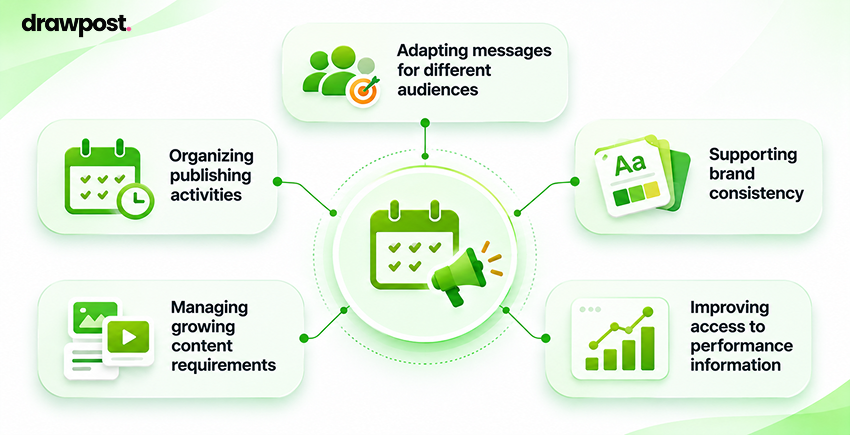
1. Simplifying content preparation: AI-powered content generation can help businesses develop initial captions, promotional messages, and visual drafts from established brand information. This reduces the effort involved in preparing routine content, particularly when a company publishes frequently.
2. Organizing publishing activities: Social media scheduling and automation allow teams to prepare content in advance and maintain a more predictable publishing routine. Employees can spend less time manually transferring approved posts between tools and platforms.
3. Adapting messages for different audiences: A marketing team can use AI to prepare different versions of an approved message for LinkedIn, Instagram, or Facebook. Human review remains important to ensure each version reflects the platform and its audience.
4. Supporting brand consistency: AI can apply documented messaging guidelines, terminology, and visual preferences when generating content. This is useful for businesses with several employees or contributors preparing posts.
5. Managing growing content requirements: Companies expanding into new markets or adding product lines often need more content. AI can support additional production without requiring every new draft to be written manually.
6. Improving access to performance information: AI-assisted social media analytics and reporting tools can help organize available engagement data and identify patterns. Marketing teams can use those findings when evaluating their next campaigns.
These capabilities explain why AI-powered social media management is attracting attention from businesses of different sizes.
But one important question remains.
Does producing content faster actually make that content more effective?
What Does Research Reveal About AI vs. Human Content?
The discussion becomes more interesting when we look beyond the number of posts a business can produce.
Research suggests that AI-generated content can perform well in certain situations. However, audience expectations, emotional connections, and perceptions of authenticity can influence the results.
AI Can Generate Content That Attracts Engagement
A study published in Public Relations Review in December 2025, titled Generative AI Outperforms Humans in Social Media Engagement, examined AI-generated and human-written social media messages.
The researchers found that AI-generated messages performed better on engagement measures in the settings they studied.
Their analysis highlighted four characteristics associated with engaging social content: fluency, interactivity, information, and tone.
For businesses, the finding suggests that AI can be effective when a task involves developing clear, structured, and engaging messages.
However, the study doesn’t establish that AI performs better than professional marketers across every campaign, platform, or business objective.
Engagement is one measure of performance. It isn’t necessarily evidence of customer trust, qualified leads, or revenue.
Human Connection Still Influences Customer Responses
Another study, published in the Journal of Business Research in January 2025, examined how people respond to marketing communications they believe were created by AI.
Across seven preregistered experiments, researchers found that perceived AI authorship of emotional marketing messages could reduce positive word of mouth and customer loyalty.
Interestingly, the effect was weaker for factual communications and when AI was used for editing rather than composing the message.
This provides a useful distinction for business communication.
AI may be well suited to helping prepare product explanations, informational posts, and routine updates.
But content involving emotional experiences, personal stories, or customer relationships may benefit from greater human involvement.
Transparency and Trust Are Becoming More Important
According to Pew Research Center’s September 2025 survey, 76% of U.S. adults said it was extremely or very important to distinguish between content created by AI and content created by people.
At the same time, 53% said they weren’t confident in their ability to identify AI-generated content.
A separate 2026 study in the Journal of Consumer Research examined AI-content disclosure on social media. The researchers found that disclosure was associated with reduced engagement in the settings studied, partly because people perceived a weaker personal connection with the creator.
These findings shouldn’t be interpreted as a reason to avoid appropriate disclosure.
Instead, they highlight the importance of understanding how audiences perceive content and maintaining authenticity when using AI.
The broader lesson is that content efficiency and customer connection aren’t always the same thing.
AI can help businesses communicate more frequently. Human judgment helps determine whether that communication is meaningful.
Where Human Social Media Managers Still Have an Advantage
Despite the growing capabilities of AI, several responsibilities remain difficult to manage through automation alone.
These activities often influence how customers perceive a business and whether they develop lasting relationships with it. The benefits of hiring a social media manager vs using AI are clearest when the job requires the judgments mentioned below –
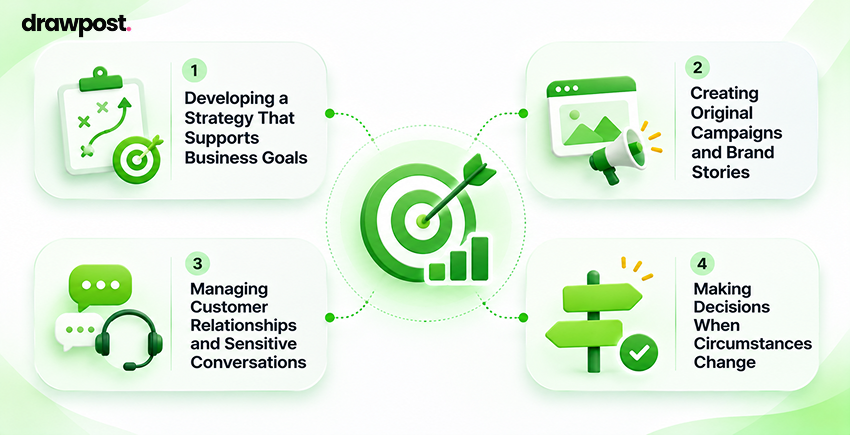
1. Developing a Strategy That Supports Business Goals
Social media strategy involves more than choosing trending topics or deciding when to publish.
A business needs to understand its customers, identify its competitive advantages, establish a clear market position, and decide how social platforms contribute to its commercial objectives.
Consider a B2B software company trying to attract enterprise decision-makers.
AI might recommend popular industry topics or generate educational posts. However, a human manager can work with sales and product teams to identify customer objections, address buying concerns, and develop messaging that supports qualified inquiries.
That level of coordination requires an understanding of the business beyond the information available in a content-generation tool.
2. Creating Original Campaigns and Brand Stories
Imagine a family-owned restaurant celebrating an important business milestone.
AI can prepare promotional captions and suggest campaign themes.
A human marketer, however, might recognize an opportunity to feature longtime customers, share experiences from the restaurant’s history, or highlight the people responsible for its success.
These details can make the campaign more distinctive because they come from the business itself.
Human creative oversight remains valuable when content depends on firsthand experience, customer insights, or original ideas.
AI can support the production process without becoming the source of those experiences.
3. Managing Customer Relationships and Sensitive Conversations
Not every social media interaction can be handled with a prepared response.
A customer may complain publicly about a service failure. Someone might ask a product question requiring specialist knowledge. A brand could also face criticism after publishing an inappropriate message.
Audience engagement and community management require an understanding of the situation and the authority to take appropriate action.
AI may help organize messages or prepare suggested responses where supported, but human managers should remain responsible for complex or sensitive interactions.
After all, customers generally expect businesses to take their concerns seriously, not simply respond quickly.
4. Making Decisions When Circumstances Change
A promotional campaign may be appropriate when it’s planned but unsuitable when the publishing date arrives.
Product availability might change. A public event could affect the message. Customer feedback may reveal concerns that weren’t considered during campaign preparation.
Human managers can reassess the situation, coordinate with other departments, and decide what should happen next.
AI can provide recommendations using available information, but the final decision should reflect the organization’s priorities and responsibilities.
This is especially important for businesses where communication errors can affect customer confidence or regulatory compliance.
Can AI Replace Human Social Media Managers in 2027?
AI can replace or reduce several repetitive social media management activities, but it cannot reliably assume every responsibility of an experienced human professional.
The practical distinction is between replacing a task and replacing an entire role.
For example, a business might use AI to prepare routine captions instead of assigning that work manually.
It may also automate content scheduling, prepare draft calendars, or organize reporting information.
These changes can reduce the amount of production work required from employees.
However, the business still needs someone to establish campaign priorities, approve important messages, manage customer interactions, and evaluate performance.
Replacing the individual responsible for those decisions is a different proposition.
Before making that decision, businesses should ask themselves:
- Who will determine the social media strategy?
- Who will verify product and promotional claims?
- Who will manage important customer conversations?
- Who will approve sensitive or high-impact content?
- Who will evaluate whether campaigns support business goals?
- Who will take responsibility if something goes wrong?
If the answers aren’t clear, the organization may not be ready to transfer more responsibilities to automation.
For many companies, AI will be most useful as a way to improve existing marketing operations rather than eliminate human involvement altogether. This is particularly true when AI and human social media management are evaluated as complementary responsibilities rather than opposing job titles.
Should Businesses Choose AI or Hire a Social Media Manager?
The right decision depends on the type of work your business needs and the expertise already available.
Let’s consider how different business requirements affect the choice.
1. Small businesses with routine content needs: A local service provider or small online store may already understand its customers and promotional priorities. AI social media management can help prepare recurring posts and organize publishing while the owner reviews content and handles customer conversations. This can be a practical starting point when a dedicated marketing hire isn’t necessary.
2. Growing businesses building a stronger brand: Companies expanding into new markets or introducing new products may require more deliberate positioning and creative direction. A human marketer can lead the strategy while AI supports content production and scheduling. This allows the business to maintain oversight without making every task dependent on manual effort.
3. Marketing agencies managing several clients: Agencies need to protect each client’s brand identity while handling different calendars, campaigns, and content requirements. AI can support repeatable production and coordination, but account managers and creative professionals should retain responsibility for client decisions, quality, and performance.
4. Businesses needing specialized creative work: A company preparing a major campaign, original video production, or executive thought leadership may benefit more from hiring an experienced freelancer or specialist. AI can assist with supporting tasks, but it doesn’t replace the value of firsthand knowledge or professional creative direction.
5. Enterprises with complex approval requirements: Larger organizations may have multiple departments, brand policies, and compliance requirements. AI can support selected workflows, but the business should establish appropriate review and accountability processes before introducing extensive automation.
The decision doesn’t have to be permanent.
A business may begin with AI-assisted publishing, introduce freelance expertise as its campaigns become more complex, and eventually build a larger marketing team.
What matters is aligning the approach with the actual requirements rather than assuming every company needs the same solution.
AI Social Media Manager Cost vs. Human Manager
Price is another important consideration, particularly for businesses trying to control marketing expenses.
According to Salary.com’s November 2026 data, the average U.S. social media manager earns approximately $9,397 per month in base salary.
The actual expense may be higher when businesses account for employee benefits, software subscriptions, recruitment, and additional creative resources.
Hiring a freelancer offers another option.
Upwork’s pricing guidance places typical freelance social media manager rates between $14 and $35 per hour, depending on experience and responsibilities.
For a business requiring 40 hours of freelance support each month, that represents an estimated expense of 560–1,400.
Human professionals can provide strategy, original creative work, customer engagement, and campaign management. But if much of their time is spent preparing routine captions and scheduling posts, businesses may be paying for work that AI could help simplify.
This is where software becomes worth considering.
How Much Do AI Social Media Management Platforms Cost?
AI social media management platforms generally cost less than hiring dedicated professionals, but their pricing structures and capabilities vary.
Some specialize in content scheduling, while others provide AI content generation, creative tools, analytics, and multi-brand management.
Here’s how several established platforms compare based on their published monthly prices as of November 2026.
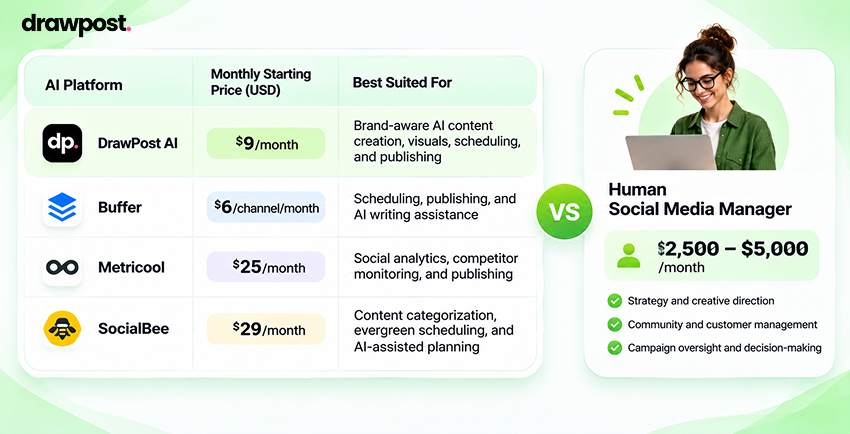
| AI Platform | Monthly Starting Price (USD) | Best Suited For |
| DrawPost AI | $9/month | Brand-aware AI content creation, visuals, scheduling, and publishing |
| Buffer | $6/channel/month | Scheduling, publishing, and AI writing assistance |
| Metricool | $25/month | Social analytics, competitor monitoring, and publishing |
| SocialBee | $29/month | Content categorization, evergreen scheduling, and AI-assisted planning |
Prices are in USD and reflect published month-to-month options. Features, connected-account limits, and content allowances vary by platform.
A lower starting price doesn’t automatically mean the software is more economical.
For example, Buffer’s Essentials plan costs $6 per connected channel per month. A business managing three channels would spend approximately $18 monthly on the subscription.
DrawPost’s Creator plan costs $9 per month for one brand and two social accounts. Businesses requiring three accounts under the same brand would need to consider the Growth plan at $49 per month.
That doesn’t mean one platform is universally more cost-effective than the other.
If your team already creates content and only needs publishing assistance, a scheduling-focused tool may be sufficient.
However, if your employees also spend considerable time preparing captions, graphics, and other creative assets, an integrated AI platform may reduce additional production work.
Similarly, Metricool may offer value to businesses prioritizing analytics, while SocialBee is relevant to teams managing recurring and evergreen content.
The important factor is whether you’re paying for features that solve your actual operational problems.
For a more detailed evaluation of features, capabilities, and pricing across leading platforms, explore our guide to the 11 Best AI Social Media Management Tools for Businesses in 2027.
How Businesses Can Combine AI and Human Social Media Management
For businesses that want greater efficiency without losing control of their messaging, combining AI with human expertise can provide a practical approach.
This is often described as hybrid social media management.
The idea is straightforward: assign repeatable activities to suitable technology while keeping people involved in decisions requiring experience, creativity, and accountability.
Here’s how businesses can organize the workflow.
1. Establish the direction: Begin with your audience, business objectives, key messages, and campaign priorities. A business owner or marketing professional should define what the company wants to achieve before introducing automated production.
2. Provide the right brand context: Give the AI platform accurate information about your products, target audience, preferred tone, visual identity, and content restrictions. These details help generated material follow your established direction.
3. Automate suitable production work: Use AI to assist with caption drafts, visual variations, calendar preparation, and other recurring activities. Keep important creative decisions and original campaign concepts under human direction.
4. Review content before publication: Check the output for factual accuracy, originality, brand alignment, and appropriate messaging. Establish additional approval requirements for sensitive content, significant promotions, and important announcements.
5. Monitor engagement and performance: Allow suitable scheduling activities to run automatically while keeping employees responsible for customer interactions and campaign adjustments. Use available analytics to understand which messages are working.
6. Improve the process over time: Review where automation reduces effort and where additional human involvement produces better results. Update your workflow based on content quality, operational efficiency, and business outcomes.
This approach allows businesses to benefit from AI and human social media management without expecting either to handle every responsibility independently.
It also provides a more practical starting point for companies that aren’t ready to commit to a fully automated operation.
How to Evaluate Whether AI Management Is Working
Introducing automation is only the beginning.
Businesses still need to determine whether the new approach is delivering better results.
A simple way to do this is to compare AI-assisted production with the existing manual process using a small group of similar content assignments.
For example, a marketing team could select twelve planned posts covering product information, educational content, and routine promotions.
Prepare some using the established manual process and others with AI assistance.
Then evaluate both approaches against the same criteria.
1. Content quality: Does the finished material provide accurate, relevant information that reflects the business?
2. Review requirements: How many revisions are needed before a post is approved?
3. Production effort: How much employee time is required to move from an idea to publishable content?
4. Brand alignment: Does the content reflect the company’s established messaging and visual identity?
5. Audience response: Are the posts generating meaningful engagement or relevant customer inquiries?
6. Business contribution: Do the campaigns support outcomes such as qualified traffic, leads, purchases, or customer retention?
The purpose isn’t to prove that AI produces better content in every situation.
It’s to identify where automation improves efficiency without introducing unnecessary revisions, quality problems, or additional operational risks.
For businesses with existing marketing teams, the findings may also reveal opportunities to redirect time toward campaign development and customer relationships.
Where DrawPost AI Fits Into Your Social Media Workflow
If your business already has a clear marketing direction but struggles to maintain consistent content production, an integrated AI platform can make the process more manageable.
DrawPost AI connects brand information, content generation, planning, scheduling, publishing, and performance insights within one workflow.
Instead of starting every post with a separate prompt, businesses can use website information to establish a brand profile and review the audience, positioning, and visual direction. Teams that need a more detailed approach to Consistent brand voice across social media can apply those guidelines during content review.
This context helps guide future content generation.
DrawPost also provides tools for creating captions and visuals, organizing calendars, and scheduling approved posts across supported social platforms.
For businesses looking to Manage Multiple Social Media Accounts, eligible plans support separate brand environments and account management.
The practical benefit is reducing the effort involved in moving content from an initial idea to scheduled publication.
However, the platform doesn’t remove the need for important marketing decisions.
Your team can continue reviewing generated content, refining messaging, and determining which campaigns deserve attention.
That makes DrawPost relevant to small businesses looking for support with routine publishing, growing teams trying to improve production efficiency, and agencies managing several brands.
Ready to Simplify Your Social Media Management?
Explore how DrawPost can help your business create brand-aligned content, organize publishing activities, and reduce repetitive work without giving up control over important marketing decisions.
Final Thoughts: Which Approach Makes More Business Sense?
AI social media managers and human professionals bring different strengths to the table.
AI can help businesses prepare content, manage schedules, and simplify recurring activities. Human managers contribute the judgment, original thinking, and customer understanding needed to guide those activities.
For businesses handling relatively straightforward content requirements, AI may provide much of the operational support they need.
For organizations developing complex campaigns or managing sensitive customer relationships, professional expertise remains important.
And for companies facing both challenges, a combination of AI and human management may be the most practical option.
Before making your decision, identify which activities consume unnecessary time, which responsibilities require professional judgment, and where technology could improve the existing process.
Because the objective isn’t simply to replace a person with software or publish more content.
It’s to build a social media operation that communicates effectively, supports business priorities, and uses available resources where they create the most value.
Frequently Asked Questions
Q. Is an AI social media manager better than a human?
An AI social media manager can be more efficient for repetitive tasks such as drafting captions, preparing calendars, and scheduling content. Human managers generally offer stronger strategic judgment, creative direction, and customer relationship management. Neither approach is automatically better for every business. The decision depends on the responsibilities involved, existing marketing expertise, content requirements, and how much human oversight the organization can provide.
Q. Can AI replace a full-time social media manager?
AI can automate selected responsibilities, but replacing an entire role requires careful evaluation. Content preparation and routine scheduling may be suitable for automation, while strategic planning, sensitive customer interactions, and campaign accountability still need human involvement. Businesses should identify who will manage these responsibilities before reducing staffing. In many cases, AI is better suited to improving an employee’s productivity than replacing the position entirely.
Q. Should small businesses hire a social media manager or use AI?
Small businesses with straightforward publishing requirements may benefit from AI-assisted content creation and scheduling, particularly when the owner can review the output. Hiring a human manager becomes more valuable when the company needs original campaigns, active community management, or specialized marketing strategy. Businesses can also combine AI software with occasional freelance support rather than immediately committing to a dedicated employee.
Q. Can AI maintain a consistent brand voice across social platforms?
AI can support brand voice consistency when provided with clear guidelines, approved examples, audience information, and relevant business context. It can help adapt messaging across different platforms while following established preferences. However, businesses should review generated content to confirm that it remains accurate, relevant, and appropriate. Human input is particularly important when brand positioning changes or communication involves sensitive topics.
Q. How much does an AI social media manager cost compared to a human?
AI is generally more cost-effective for routine content creation and scheduling. DrawPost costs 9–99 per month, while a U.S. social media manager earns an average base salary of $9,397 per month. Freelancers typically charge 14–35 per hour. For businesses with limited budgets, AI offers substantial cost advantages, while human professionals provide the strategic expertise, creative judgment, and customer engagement that automation cannot fully replace.
Q. What is the most effective way to combine AI and human social media management?
Start by assigning strategy, campaign direction, and important approvals to a business owner or marketing professional. Use AI to support recurring tasks such as content drafting, calendar preparation, and scheduling. Keep human oversight for accuracy, originality, customer interactions, and performance decisions. Review the workflow regularly to determine where automation reduces effort and where professional involvement contributes more value.
Our Latest Insights

10 Social Media Management Mistakes Every Business Should Avoid
Discover 10 common social media management mistakes businesses make and learn practical ways to improve engagement, maintain consistency, and grow your brand.

How to Manage Multiple Client Social Media Campaigns During the Holidays
Discover how marketing agencies can streamline multiple client social media campaigns during the holidays with workflows, batching, and automation tools.
In-House vs. Outsourced Social Media Management vs. AI Tools: Which Is More Cost-Effective?
Compare in-house vs. outsourced social media management and AI tools. Explore costs, pricing, ROI, and how to choose the most cost-effective approach.